

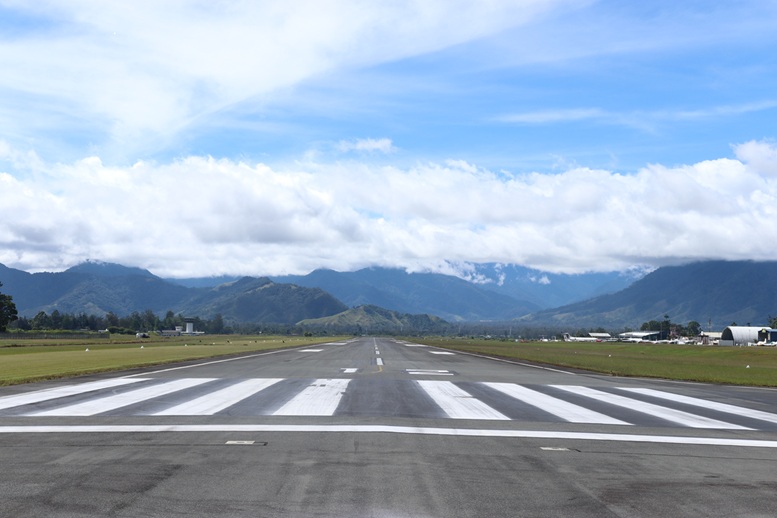
The aviation future of Mt Hagen’s Kagamuga Airport has entered a decisive construction phase, with major runway works commencing on June 4 as Papua New Guinea accelerates plans to position Mt Hagen and the Highlands region as a key agricultural export hub for Asia-Pacific markets.
At the centre of that national direction, Civil Aviation Safety Authority Director Benedict Oraka said Kagamuga is being strategically positioned as a critical node in Papua New Guinea’s long-term aviation and export framework.
Speaking during the CIMC Transport and Infrastructure Sectoral Committee meeting on June 3, Oraka said airport upgrades nationwide are designed to reshape the country’s aviation capacity, reduce congestion, improve aircraft handling capability, and support a shift toward larger fleet operations such as the Boeing 737 and Airbus A220.
“Mt Hagen has the potential to become a major agricultural export hub for the Asian market. We should target markets such as Indonesia, India and China. If we grow the Highlands as an agricultural basket, we can increase production, expand exports and generate revenue that is not presently there,” Oraka said.
“For Kagamuga and other airports, the direction is clear—to build capacity that can safely handle bigger aircraft and growing cargo demand,” Oraka noted during the briefing.
The comments come as Kagamuga Airport undergoes a K39.4 million runway upgrade that is now transitioning from planning into active construction. The project is backed by a delivery schedule running through to December 2026 and is designed to align airport capacity with rising freight demand from the Highlands’ agricultural production zones.
National Airports Corporation (NAC) confirmed that runway pavement repairs at Mt Hagen (Kagamuga) Airport commenced on June 4 and are expected to take approximately nine months to complete, weather permitting. The works are considered essential to enabling safe operations for heavier aircraft types, including the Airbus A220 and Boeing 737.
The upgrade was officially launched on April 28, 2026, in Mt Hagen, Western Highlands Province, by Civil Aviation Minister Wake Goi and Western Highlands Governor Wai Rapa.
National Airports Corporation Acting Managing Director Dominic Kaumu said the runway works are essential to meet rising aviation demand and enable safe operations for newer aircraft types.
He confirmed that contractors have already been mobilised, with the project timeline aligned to national aviation expansion targets and peak travel periods expected in 2026.
According to Kaumu, the works will be carried out on the central 18-metre portion of the runway, including turning nodes and Taxiway B, and will involve asphalt overlay, runway grooving, new pavement markings, aircraft parking bay improvements and drainage upgrades.
Kaumu emphasized that all works will be executed under strict safety and operational standards to ensure continued airport functionality during the construction period.
Western Highlands Governor Wai Rapa described Kagamuga Airport as one of the most important economic gateways in the Highlands region, handling high passenger volumes and placing increasing pressure on existing infrastructure.
He called for strict quality control in construction delivery and urged community cooperation to ensure the project is protected and completed to a high standard.
Civil Aviation Minister Wake Goi said the upgrade is part of the broader Civil Aviation Development Investment Program Phase Three (CADIP III), which will continue rolling out additional runway and terminal improvements from 2028 onwards.
He also outlined complementary measures aimed at modernising the airport environment, including the relocation of informal markets and tighter regulation of trade activities around the terminal precinct.
With works now officially underway, Kagamuga Airport stands at the centre of Papua New Guinea’s aviation reset—reframing the Highlands from a domestic regional hub into a strategic export corridor designed to move agricultural produce into fast-growing Asian markets.