

Posts by Jordan VELA | PNG Haus Bung
POSTS BY AUTHOR
Jordan VELA
Author

Jordan VELA

SOCIAL INCLUSION TAKES CENTRE COURT AT BOMANA VOLLEYBALL TOURNAMENT
Social inclusion took centre court at Bomana Correctional Institution’s Female Wing, where female inmates and correctional officers came together for a two-day volleyball tournament as part of the country’s 51st Independence celebrations.Held from Sept. 17 to 18, the first-of-its-kind tournament brought together female officers from Bomana, the Correctional Services Training College and the Correctional Service headquarters in Hohola, alongside female inmates.The tournament was supported by K8,000 through the Correctional Service’s Gender Equality and Social Inclusion (GESI) program, which promotes gender equality and social inclusion within the service.Bomana Female Wing officer Cpl. Ipak Kove Mollen was the lead organiser of the competition, working with the Correctional Service GESI desk.In an interview with PNG Haus Bung, Cpl. Mollen said the tournament was organised to promote social inclusion through sporting activities while creating an opportunity for female officers from different Correctional Service establishments to come together.She said the Port Moresby tournament was a starting point, with hopes of expanding it to include female officers from correctional institutions around the country through next year’s Commissioners Cup.“This game brings together female officers from three of our CS establishments here, from Bomana Prison, CS HQ and CS Training College, together to promote social inclusion in the Correctional Service, not only through set duties but also in sporting activities,” Cpl. Mollen said.“Especially for female officers from all prisons around the country to come together and participate, and not only in volleyball but other sports as well,” she said.“Most of the time we don't come together, so I'm hoping next year we can organize this tournament for all our female officers.”Cpl. Mollen also acknowledged the support of the CS commissioner and GESI desk, while calling for equal opportunities for women in field operations.Bomana Commander in Charge Chief Superintendent Yelly Oiufa said the tournament formed part of the 51st Independence celebrations and brought female officers from different parts of the service together.“After so many years, it's a first of its kind. It's so good seeing female officers from HQ, Training College and Bomana coming together. That should happen all the time,” Oiufa said.“And to sum it all, I want this to happen more because it brings unity with all the women in the service.”Oiufa also welcomed the decision to include female inmates in the competition.“I appreciate the GESI program for also including the female inmates to take part in this tournament,” he said.He acknowledged Correctional Service Commissioner Noel Sarei for his recognition of gender equality within the service and called for the GESI program to continue the initiative beyond the first tournament.The competition ended with Female Wing 2, made up of female inmates, winning the tournament.Traditional dancing by the families of female correctional officers also formed part of the program, adding to the Independence celebrations at the institution.Commissioner Sarei was unable to attend the ceremony, but his wife presented K2,000 on behalf of the family to support the event.
Published on September 22, 2026
"O ARISE ALL YOU SONS OF THIS LAND" PM CALLS TO ALL MEN AS PNG STEPS INTO THE NEXT 50
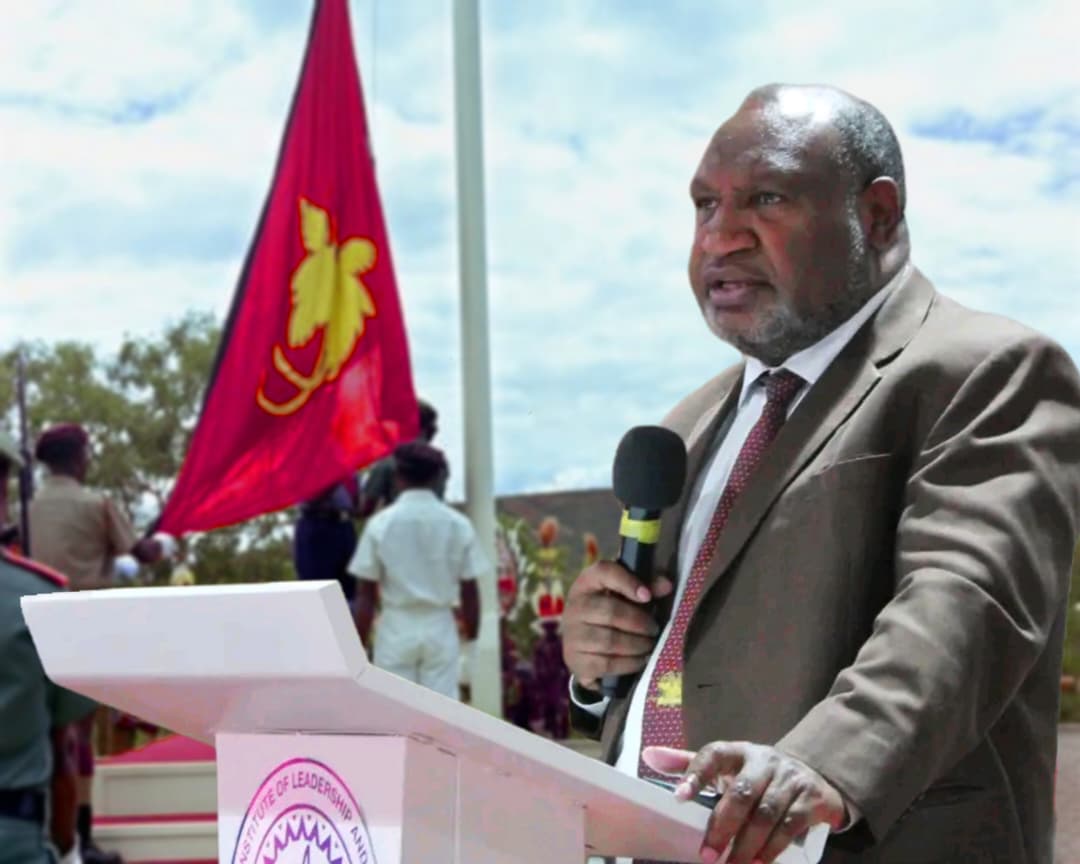
As the country opens the chapter into the next 49 years, Prime Minister James Marape called on men across Papua New Guinea to take greater responsibility for leadership and accountability, drawing on the national anthem’s call, “O Arise All You Sons of This Land.”“Men of our country, as the national anthem calls, must take responsibility. It is us men who starts tribal fights, who block road, who is rough and reckless in the society,” Marape said.“No wonder in 1975 from our prophetic eyes of our founding fathers and mothers of our country, they embedded into the national anthem ‘O Arise All You Sons of This Land.’ Sons of our country must take up leadership, not leadership to abuse, but to contain and shape the country into the next 49 years that we are stepping into.”He then expanded on what he said the founding leaders intended when the anthem was written half a century ago.“Fathers of our country saw it correct that 50 years later the sons will be reckless, so they wrote it down, ‘O Arise All You Sons of This Land.’ Sons of this country, take leadership with grace, love and care of this country, including mothers, daughters and women amongst us,” he said.Marape also drew on Genesis 3:9, which recounts God asking Adam, “Where are you?” after Adam and Eve ate from the forbidden tree.He used the passage to illustrate his view that men in leadership must accept responsibility rather than shift blame to others.“Do you ever realize that when Eve picked the fruit, Genesis 3:9 said God didn’t come looking for Eve. God came looking for Adam and God called out to Adam, ‘Where are you?’ Because the reason is simple. God created Adam first. God gave work to Adam first. Adam was supposed to look after Eve,” Marape said.He then extended the message to leaders across the country’s institutions.“And God calls to all of us in leadership, Prime Minister, ministers, chief secretary, judiciary, the Parliament and in all levels of leadership. That when you are leading the point of accountability comes to the greatest,” he said.Marape said the call to accountability applies beyond political leadership to men in communities and other institutions.“I extend this to all men in the society that claims as leaders, clan leaders, tribe leaders, church leaders, business leaders, community leaders, that women will support, but men O Arise all you sons at step into our 51st” he said.He said the words of the national anthem remain relevant as the country enters the next stage of its development, urging men to understand leadership as a responsibility to society rather than an opportunity for abuse.Marape made the call during the closing ceremony of the weeklong Reset@50 forum at SILAG on Sept. 14, linking the anthem’s words to the responsibility he believes men carry in leading families, communities and the country.
Published on September 17, 2026
SOPNG PRESIDENT CONGRATULATES ATHLETES AS MONI PLUS UNIFIED FOOTBALL COMPETITION CONCLUDES
Special Olympics Papua New Guinea President Takale Tuna has congratulated athletes who competed in the 2026 Moni Plus Unified Football Competition, which concluded Saturday at Sir John Guise Stadium in Port Moresby.Tuna also acknowledged Moni Plus for sponsoring and supporting the competition and expressed hope for a bigger event next year.Moni Plus Assistant Manager of Marketing and Branding Doeveri Asi said the company was pleased to support the competition.The one-day competition brought together 21 teams, comprising 11 male teams and 10 female teams, following the divisioning round held on Sept. 5.The teams competed across four pools, with two male and two female pools. Teams were placed according to similar skills and abilities, with placings awarded in each pool.MALE DIVISION POOL A1st: Gerehu Swamp2nd: St. Peter Channel Primary School3rd: Academy of Inclusive LearningMALE DIVISION POOL B1st: Callan Inclusive Education Resource Centre2nd: Tubusereia3rd: GwarumemaseFEMALE DIVISION POOL A1st: Gerehu Swamp 12nd: Cheshire Inclusive Education Resource Centre3rd: TubusereiaFEMALE DIVISION POOL B1st: Callan Inclusive Education Resource Centre2nd: Red Cross Inclusive Education Resource Centre3rd: Boreboa Primary SchoolTrophies were presented to the top-placed teams, while all participating athletes received participation medals and school kits.The competition brought together athletes with and without intellectual disabilities in a modified form of soccer, with participants competing alongside Unified Partners.The competition was open to participants aged 10 to 21, with seven players on the field and three reserves for each team.
Published on September 17, 2026
RESET@50 PROPOSES STANDALONE CIMC
A proposal to establish the Consultative Implementation and Monitoring Council (CIMC) as a standalone organization was among four documents presented to Prime Minister James Marape at the closing ceremony of the RESET@50 weeklong forum closing ceremony yestreday.Institute of National Affairs (INA) Executive Director Paul Barker presented the proposal, which outlines a possible transition for CIMC after almost three decades of operating under INA.Barker said CIMC was established in 1998 following a national economic summit during the government of former Prime Minister Bill Skate.He said CIMC was initially established under the auspices of the INA and operated as a program of the organization while maintaining its own council.Barker said discussions with civil society over several years had led to the proposal for CIMC to become an independent entity.“What came out of the CSO discussions and some dialogue over the course of time, over a number of years, was that at some stage, CIMC should probably be established as a sort of standalone organization, operating no longer as part of INA, but as a CSO.”Under the proposal, CIMC could be registered as a separate civil society organization under the Associations Act, with the possibility of additional legislation formally recognizing its role.Barker said the proposed structure would give CIMC greater autonomy while maintaining participation from government, civil society and the private sector.“It's a three-way entity, so it needs the ongoing commitment from civil society, private sector and government. So they need to trust it enough so that they feel happy to engage with it, and that they're going to get positive, useful outcomes as a result.”He said government participation would remain important to ensure dialogue between the three sectors.“You need government to make a commitment and to be there in the room to respond to civil society, but also to highlight policies.”Barker said the transition would require further decisions on CIMC’s legal structure, funding and administration.He said the INA would continue to be involved as a civil society organization and think tank, while the exact relationship between the two organizations would be determined during the transition.
Published on September 15, 2026
PNGDF LAUNCHES STARLINK TO STRENGTHEN COMMAND, COMMUNICATIONS
PNG Defence Force has launched Starlink to improve command and communications with personnel and vessels operating in remote parts of the country and at sea.The satellite internet service was launched at Murray Barracks Port Moresby today, September 15th as the PNGDF works to address communication challenges caused by the country’s difficult terrain and limited connectivity in remote areas.PNGDF Commander Rear Adm. Philip Polewara said reliable communication is critical to maintaining command over personnel and assets deployed from headquarters.“That’s how we have to command a force, not by sitting here in my office and signing papers and signing orders, when I cannot reach the whole ship that is at sea,” he said.Polewara said the communication gap could affect the PNGDF’s ability to maintain control of its forces, particularly personnel and vessels operating at a distance.“If we cannot communicate the force, the force will fragment and dismantle,” he said.PNGDF ICT Director Lt. Col. Joe Mwawesi said Starlink uses a network of low-Earth-orbit satellites to provide high-speed internet connectivity in remote and geographically challenging locations.He said the technology forms part of the PNGDF’s efforts to modernize its communications systems and improve operational effectiveness.“As we continue to modernise the Papua New Guinea Defence Force and strengthen our communications capability, initiatives such as this demonstrate our commitment to leverage emerging technologies,” Mwawesi said.He said the service is expected to support national security, operational readiness and command and control across the Defence Force.The PNGDF says improved connectivity will be particularly important for personnel and assets operating in areas where existing communication networks are limited.
Published on September 15, 2026
TUMBUNA PIKININI FESTIVAL REVIVES CULTURE AND TRADITION IN AROMA COAST
Schoolchildren from across the Aroma Coast took part in the first Tumbuna Pikinini Festival last week, as organizers work to preserve traditional culture and pass knowledge to a younger generation.The two-day festival was held at Aroma Primary School on Sept. 9 and 10, bringing together communities from 19 wards of the Maopa Local Level Government.Students from primary, elementary and early childhood schools across the Aroma Coast performed traditional dances, songs and band performances, showcasing the cultural diversity of the communities.The festival was officially opened on Wednesday by National Cultural Commission Festival and Events Manager Eugene Avediba, who represented NCC Director Steven Kilanda, and Maopa Levapuka Tovi Cultural Association Chairman and Festival Director Avis Vanua Vevao.The festival was held under the theme, “Promote Peace and Unity in Diversity, Rebuild the Connection Between Younger Generation and Their Heritage.”Vevao said the festival was established to promote and preserve the Tovi dance and pass knowledge of the tradition to children.He said the Tovi dance was traditionally performed by adults and elders, but schools were included to help keep the tradition alive.“Because the culture is dying in Aroma Coast, I involve schools, so students showcase their diversity, their pride and identity,” Vevao said.He said Western lifestyles were influencing traditional practices and children needed opportunities to learn about their cultural heritage.Vevao said the Tumbuna Pikinini Cultural Festival would become part of the education curriculum in schools across the Aroma Coast.He said incorporating the festival into schools would give students an opportunity to learn about their culture and traditions while helping pass traditional knowledge to future generations.Vevao also explained the traditional significance of the Tovi dance, saying it was performed as a ritual before men went to fight.“So when dancing, if anyone fell off the coconut trunk, then it’s a sign that, he will die,” he said.“The men will feel sick, then after two weeks he’ll die.”The inaugural festival is expected to be followed by a larger event planned for March 2027.
Published on September 14, 2026
SPECIAL OLYMPICS UNIFIED FOOTBALL COMPETITION STARTS SATURDAY
The Special Olympics Papua New Guinea Moni Plus Unified Football Competition 2026 will commence this Saturday at Sir John Guise Stadium, with 21 teams competing in a one-day tournament.The competition will begin with preliminary matches before teams progress to the grand finals.The 21 teams comprise 11 male teams and 10 female teams, divided into four pools, with two pools for each gender.Last Saturday 5th September, the organizers held the divisioning round to assess and organise participants according to their age ranging from 10 to 21 and so their ability before placing the teams into their respective pools.The competition is proudly sponsored by Moni Plus and organized by Special Olympics Papua New Guinea.Unified Football is a modified form of soccer designed to allow athletes with intellectual disabilities and players without disabilities, known as Unified Partners, to compete together on the same team.Each team will have seven players on the field and three reserves. Matches will be played over 20 minutes, consisting of two 10-minute halves.Special Olympics Papua New Guinea Program Support Staff Eunice Wanjumoe said the sport brings together athletes and Unified Partners of similar age and skill levels to play alongside each other.She said the format promotes social inclusion, teamwork and friendship while giving everyone an opportunity to participate and enjoy the game together.
Published on September 11, 2026
THREE NEW BILLS TO EXPAND PNG’S DIGITAL REGULATION
NICTA is developing three new Bills to expand regulation of Papua New Guinea’s digital space, covering data protection, digital identity and emerging technologies.The proposed reforms were discussed during a two-day stakeholder consultation involving ICT professionals from government departments, state-owned enterprises and the private sector in Port Moresby on Aug. 27 and 28.NICTA Chief Executive Officer Polume Lume said the reforms are needed because the existing regulatory framework largely focuses on traditional telecommunications.“The current regulatory setup basically focuses only on connectivity and accessibility, as well as affordability,” Lume said.He said emerging areas such as cybersecurity and digital identity are not adequately covered under the current framework.“The emerging related issues that come about, such as cybersecurity, digital ID and stuff like that, they are not covered well within the current regulatory setup,” he said.Lume said the proposed Bills are intended to broaden the country’s digital regulatory framework.“The idea is now to continue to expand that framework so that we now can accommodate those emerging policy related issues,” he said.DATA GOVERNANCE AND PROTECTIONOne of the proposed laws is the Data Governance and Data Protection Bill 2026.The Bill would establish a national framework for how data is collected, used, protected, shared and managed across the public and private sectors.It proposes requirements for organizations that collect or process personal information, including safeguards for sensitive information and children’s data.The proposed framework would also give individuals greater control over their personal information.People would have rights to know how their data is being processed, access their information, request corrections and, in certain circumstances, seek restrictions on its use.The Bill also proposes rights relating to erasure, objection and data portability, as well as the ability to seek compensation where a person suffers loss or damage because of a breach of the proposed law.Organizations would have responsibilities relating to data security, retention, breach notification and lawful processing.The proposed system would also provide for complaints, investigations, audits, enforcement and redress.The Bill also addresses how government data is managed, including data classification, quality, interoperability and information sharing between government systems.It proposes a National Data Catalogue and national data exchange platform, along with controls for restricted, confidential and strategically significant information.The proposed framework also addresses cross-border data transfers and sovereign hosting, particularly where sensitive information is involved.DIGITAL IDENTITYDigital identity is another part of the proposed reforms.Lume compared a digital ID with existing identification documents such as passports.“Even your passport is also just a very similar approach on that. So if we can be able to get a digital ID, then it addresses a lot,” he said.He said digital identity could also help make digital interactions safer by allowing people to identify who they are dealing with.“It also creates a safe environment as well, so that you know that any unknown number that comes in, there’s a name to that. There’s an ID to that,” Lume said.The proposed framework is intended to support trusted digital services and stronger authentication.ARTIFICIAL INTELLIGENCEArtificial intelligence is also included in the proposed digital reforms.The consultation document proposes an interim, risk-based approach to AI governance, including safeguards for prohibited practices and high-risk AI systems.High-risk systems could be subject to impact assessments, bias testing, audit records and transparency requirements.Human oversight is also proposed where automated decisions could materially affect people’s rights or access to significant public services.The three Bills remain subject to stakeholder consultation and the legislative process before they can become law.
Published on September 8, 2026
PNG MOVES CLOSER TO 5G AS NICTA CLEARS SPECTRUM
Papua New Guinea is moving closer to 5G mobile services after NICTA announced today that it is ready to issue licences for 5G using the 2.6 GHz and 3.5 GHz spectrum bands.NICTA Board Chairman Brian Riches made the announcement at the authority’s head office, calling it a milestone for PNG’s digital economy.“I am very pleased to announce that today NICTA is ready to issue licenses for 5G mobile services in Papua New Guinea,” Riches said.He said NICTA had completed the required legal, technical and regulatory processes to make the spectrum available to qualified mobile operators.“NICTA has completed all due process on 5G spectrum bands,” Riches said.“NICTA is formally confirming that the 5G spectrum band is now available to be licensed to qualified mobile operators in Papua New Guinea.”The 2.6 GHz and 3.5 GHz bands will allow operators to provide both 4G and 5G services.Riches said the decision would support faster speeds, greater network capacity and lower latency for mobile users.“This will allow operators to deliver faster speeds, lower latency, greater reliability and improved customer experiences,” he said.NICTA said the rollout will initially focus on urban areas, where demand for high-speed mobile services is expected to be greatest.Vodafone PNG has committed to providing 5G services across the National Capital District and at least one additional city within 18 months.The company is also expected to reach 20% of PNG’s population within 36 months and 30% within 60 months.Each mobile operator that receives High Demand Spectrum will also be required to extend 4G coverage to 20 new sites under the Universal Access and Service programme.Riches said the spectrum licensing will also generate revenue that NICTA intends to use to support connectivity in underserved and unserved communities.“NICTA intends to use these resources to support initiatives that extend digital connectivity to underserved and unserved communities,” he said.NICTA CEO Polume Lume described the announcement as an important step in the regulator’s digital transformation efforts.“Today’s gathering is basically one of the very important milestones in our journey towards supporting digital transformation,” Lume said.He said NICTA would continue shaping the regulatory environment to support innovation and consumer welfare.Riches said NICTA would continue monitoring operators after licences are issued.“All rollout commitments, coverage obligations and quality-of-service requirements will be independently audited,” he said.“Where operators fail to meet their obligations, enforcement mechanisms and penalties will apply.”According to the Global Mobile Suppliers Association, PNG joins more than 150 countries that had launched or soft-launched 5G networks as of July 2026.
Published on September 4, 2026
FINANCIAL INCLUSION MUST GO BEYOND ACCESS| DPM ROSSO
Financial inclusion must go beyond giving people access to financial services, with safety, trust, and the ability to use those services effectively also critical.Speaking at the official opening of the 2026 Alliance for Financial Inclusion Global Policy Forum at the APEC Haus in Port Moresby, Deputy Prime Minister John Rosso said Papua New Guinea’s geography and large rural population make conventional approaches to financial inclusion difficult.He said about 80% of the country’s population lives in rural communities spread across mountains, river systems and islands, requiring financial institutions to explore new ways of delivering services.“Our experience has also taught us something more fundamental and that is access is only the beginning. Opening an account does not by itself create financial security.”“Providing financial services does not result in meaningful financial inclusion if people cannot use those services safely or with confidence.”“Bringing more people into the financial system cannot be regarded as progress if the system they enter is unsafe or unworthy of their trust.”DPM Rosso said technology provides an opportunity for countries such as PNG to overcome barriers created by geography, infrastructure and cost, but innovation must be accompanied by safeguards.“Technology gives countries such as ours an opportunity to overcome barriers of geography, infrastructure and cost.”“It allows us to bring financial services to communities where a conventional bank branch may never be viable.”“But with opportunity comes the responsibility. As services become faster and more accessible, financial institutions must ensure that the products they provide are safe, reliable and appropriate.”“Consumers also need to understand the services they are using. Their money and personal information need to be protected.”He stressed that regulators must ensure innovation takes place within a framework that protects consumers and maintains confidence in the financial system.“Yes, innovation is important, but innovation does not remove that responsibility.”He also linked financial inclusion to women’s control over financial resources, saying access to financial services should not leave people more vulnerable to financial abuse.“The same principle applies to financial inclusion for women and their ability to have control over their own financial services.”“In Papua New Guinea, our work through Empower Finance is bringing financial institutions together to examine how financial products and systems can be misused as instruments of financial abuse and what practical safeguards can be built into those services.”“A person is not genuinely financially included if access to financial services makes them more vulnerable. Trust, safety and control over financial resources are part of inclusion too.”Additionally, DPM Rosso highlighted that financial inclusion also has an important role in helping communities and businesses prepare for and recover from economic and climate-related shocks.“Our communities in the Pacific Islands, among those exposed to climate change, financial services cannot prevent a drought, a flood or a severe weather event, but they make an enormous difference to whether people and businesses are able to prepare for them, absorb the shock and recover.”He noted that PNG has included inclusive green finance into its wider financial inclusion agenda, shifting the focus to implementation following discussions at the Global Inclusive Green Finance Conference held earlier in the week.“The challenge now is to make them work. The test is not simply whether a policy exists, the test is whether that policy leads to practical outcomes.”“Can farmers obtain finance to make their livelihoods more resilient? Can a small business invest in technology or equipment that allows it to grow? Can a household withstand an economic or climate shock without falling into deeper hardship? Can financial institutions develop products that respond to real needs while remaining commercially sustainable?”He stated that responsibility for implementation does not rest with regulators alone, but requires cooperation among governments, regulators, financial institutions, development partners, technology providers, and communities.“A resilient and inclusive financial system depends on all of its participants and on each one understanding the responsibility they carry.”He said the AFI network provides an opportunity for policymakers and regulators from emerging and developing economies to share experiences and learn from both successful and unsuccessful reforms.“Peer learning is not about simply taking another country’s solution because it has worked elsewhere.”“It is about understanding what was tried, why it was tried, what worked and what did not, and what might be adapted to our own circumstances.”DPM Rosso said PNG enters the forum with its own experience and challenges while remaining open to lessons from other AFI member countries.“We have experience that we are proud to share. We have challenges that we have yet not resolved. And we have much to learn from the experience of others.”He said the central challenge for financial inclusion is to build systems that people can trust and use safely.“Financial inclusion cannot be meaningful if people are brought into a financial system that they cannot trust, cannot use safely and cannot rely upon when circumstances become difficult.”“An economy cannot be resilient while large parts of its population remain financially excluded.”“Our task is not simply to bring more people into the financial system; it is to build financial systems worthy of their participation.”He reinforced that these systems must be stable, trusted, and capable of allowing people to participate, invest, adapt, and recover.Port Moresby is hosting around 700 senior officials and financial sector leaders from September 1 to 4 for the 2026 AFI Global Policy Forum, a four-day summit dedicated to shaping resilient and inclusive financial systems.
Published on September 3, 2026
ICCC BILLS FOR PROSECUTIONS TO BETTER ITS MANDATE
Independent Consumer and Competition Commission (ICCC) Commissioner and Chief Executive Officer (CEO) Mr. Roy Daggy said prosecution would strengthen the commission’s work however, current legislation limits its mandate and powers as a regulator.Therefore, under the ICCC’s new five-year Corporate Plan, the commission aims to expand its regulatory powers through the proposed Competition and Consumer Protection Bill.“As a regulator, we never complete the process. The process we need to make sure those non-compliant cases are prosecuted, but now we currently have our additional bill, Competition and Consumer Protection Bill, which will go into Parliament hopefully by November,” Mr. Daggy said.“If we have this new bill in, we will have more powers, and that can take us down to the road of prosecution.”Mr. Daggy announced that the ICCC will begin public consultation on the proposed bill on September 7, describing it as an important part of the legislative process.He said his target is to have at least five non-compliance cases prosecuted in court annually, with decisions handed down.“For me, being around, I will make sure annually we prosecute at least five cases that go to the court, and we get the decision.”Successful prosecutions would help deter businesses from continuing to breach regulatory requirements.“A lot of people, when we want them, they know, but there is no penalty.”He said some businesses currently pay relatively small penalties and walk away without facing the full prosecution process.“They just pay a penalty which is less, say. They walk away,” Daggy said.In addition, ICCC has amended the Price Regulation Act, setting penalties of up to K10,000 for primary offences and up to K30,000 for repeated non-compliance.“The power is there. Now the next step is to take them to the court to make sure they are prosecuted.”The commission plans to strengthen monitoring of unfair trading activities and develop stronger competition law expertise.Mr. Daggy highlighted that activities such as cartel behaviour and bid rigging need greater scrutiny, particularly in public procurement.“A lot of things are happening without being properly monitored or noticed.”Moreover, the ICCC has partnered with the National Procurement Commission through a memorandum of understanding (MOU) to monitor and identify possible bid rigging in public procurement.This partnership will allow the two agencies to monitor public bidding for contracts processed through the NPC.The ICCC will also look at dominant businesses that abuse their market power to crowd out smaller players.The proposed legislation is part of the ICCC’s wider plan to strengthen consumer protection and ensure markets operate fairly and competitively.Mr. Daggy emphasized that the commission’s enforcement decisions would be based on evidence, research, and data rather than pressure.“It will act with its independent power, honesty and fairness, and making sure decisions are based on evidence, not on pressure or coercion,” he concluded.
Published on September 3, 2026
ICCC PLANS TO HAVE AGENTS IN EVERY PROVINCE
The ICCC plans to establish a regulatory presence in every province as part of its five-year Corporate Plan to bring consumer protection and market monitoring closer to Papua New Guineans.ICCC Commissioner and Chief Executive Officer Roy Daggy said the commission currently operates offices in four regional centres, leaving other provinces without a permanent ICCC presence.“One of the things that we can do in the next five years is to make sure we have ICCC offices present in every town and city in the country,” Daggy said.He said the expansion would allow the commission to handle complaints, gather information and monitor compliance in real time.“This is to make sure our presence is there, and we also make sure enforcement power is effective,” he said.The ICCC has already signed about 18 memorandums of understanding with provincial governments, with four remaining to complete the process.Under the arrangements, ICCC agents will work within provincial governments while being appointed as ICCC agents.Daggy said the agents would represent the commission in the provinces and report monthly to the ICCC’s regional offices.“So, two agents per province that represent us, and they submit monthly reports,” he said.He described the current arrangement as a temporary step towards establishing a permanent ICCC presence across the country.“But in the long run, for me being around for the next five years, is I want to make sure an officer that wears ICCC badge with an ID was employed by ICCC, who is working the town,” Daggy said.He said the long-term vision was to have ICCC employees physically operating in provincial towns and monitoring businesses.“For example, in Wewak, I want to see an ICCC employee walking the streets of Vanimo, checking every store, every service station, and also in Vanimo, in Wewak, in Kimbe. So, for example, that’s how we want to go” he said.Daggy said the provincial presence would strengthen the commission’s ability to respond to complaints and identify compliance issues closer to where they occur.He said the ICCC also wanted to improve its systems so consumers, including people in rural and disadvantaged communities, could more easily raise concerns.“Sometimes the regulatory powers, you know, it’s limited to certain areas, and we don’t hear from them their complaints, what they have, the issues,” Daggy said.He said the commission would work towards an integrated and modernized system capable of capturing complaints and queries from consumers and other stakeholders across the country.The ICCC has also upgraded its website to provide consumers with an online enquiries and complaints platform.Daggy said consumers could submit details and descriptions of complaints through the platform, allowing the commission to receive them in real time.“It’s a real-time turnaround for us to address all the complaints that consumers have,” he said.He said the ICCC would continue developing its information and communications technology systems to bring more of its services online.“We want to do innovations in our ICT, information and database system, so that we want to integrate all our work online,” Daggy said.The expansion of the ICCC’s provincial presence forms part of its wider plan to strengthen consumer protection, improve compliance and ensure markets work for people across Papua New Guinea.
Published on September 1, 2026