

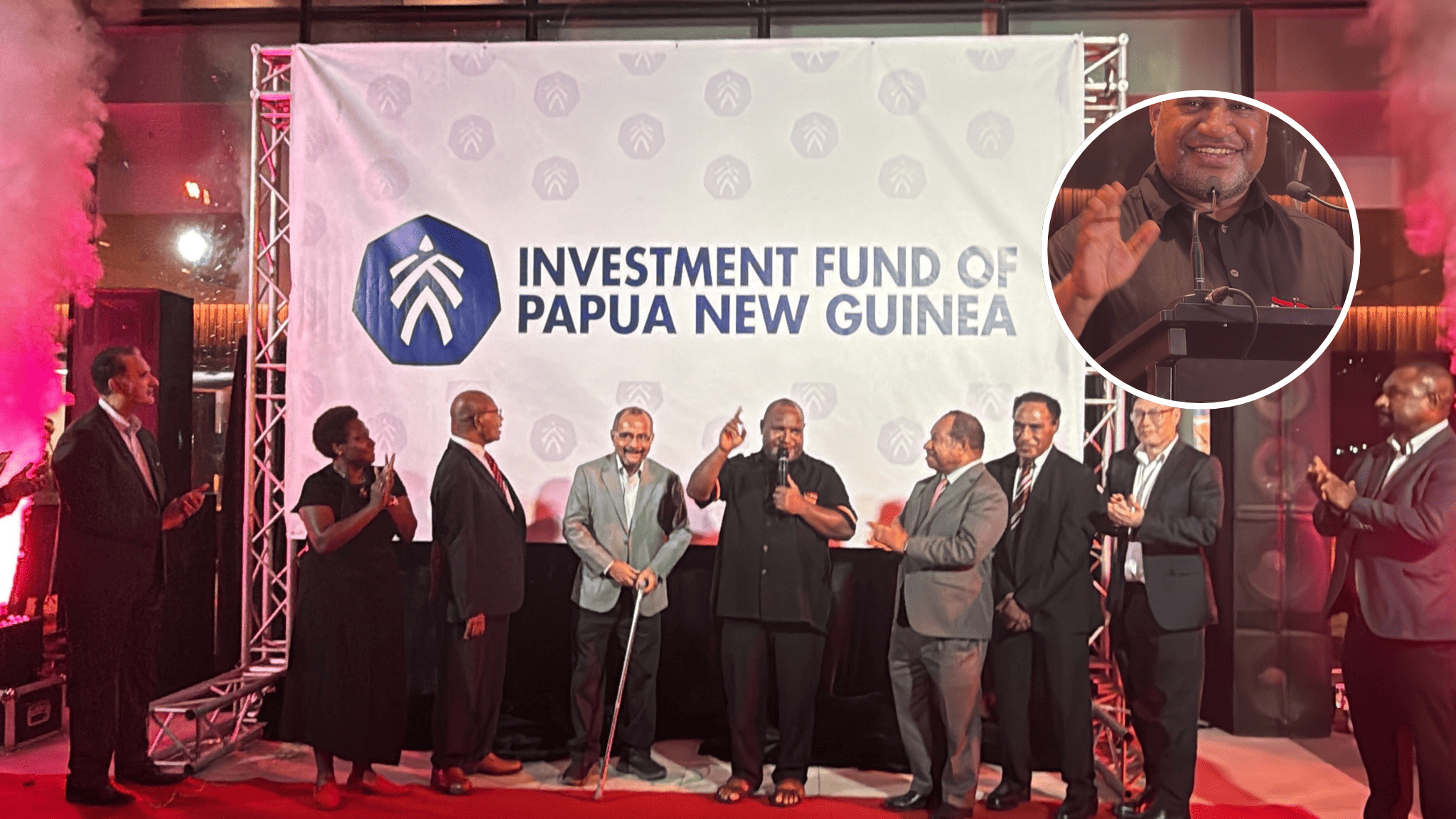
Prime Minister James Marape has urged the Investment Fund of Papua New Guinea (IFPNG) to open its doors to ordinary citizens, saying broad public participation and strong safeguards against political interference will be essential to its success.
Speaking at the unveiling of the fund’s new name and branding at APEC Haus on Thursday evening, Marape described the rebranding of the Pacific Balanced Fund as an opportunity to build a wider savings and investment culture and help Papua New Guineans share in the country’s economic growth.
“Let’s open up for the mums and dads and every other Papua New Guinean out there instead of just us in the white-collar space,” he said.
The event was attended by fund representatives, government ministers, investment-sector leaders and local businesses. Marape said the fund should be accessible to people beyond formal employment and established businesses, including farmers, market sellers, landowners and small-scale producers.
Marape said modest, regular contributions from many households could build significant investment capital over time. He suggested that families might be able to save K50 a month by reducing discretionary spending, and argued that contributions gathered from a large number of people could accumulate into a substantial pool.
“If one million families find K50 a month and you compound and aggregate this over 10, 15, 20 years, this basic simple contribution can create the wealth we want for our country through this structure,” he said.
He encouraged the fund to find ways to involve people earning money through agriculture and small businesses, including coffee, cocoa, vanilla, oil palm and copra growers, as well as forestry operators and landowners.
Marape also linked community investment to stronger connections between families, production and markets. He said people should be able to participate in economic activity where they live, rather than being excluded from investment because they lack formal jobs or access to financial institutions.
The Prime Minister’s remarks echoed IFPNG’s stated ambition to broaden participation in national investment. At the same event, fund chairman Jordan Paul said the institution intended to raise new capital and give ordinary Papua New Guineans a greater opportunity to invest in the country’s development.
Marape said the fund’s long-term success would depend on protecting it from political influence and ensuring its governance structures were strong. Reflecting on the history of public and investment institutions, he warned that political interference and misuse of funds could undermine public confidence.
“What we’re doing will be totally in vain if we don’t get sticky political hands out of the picture and set a structure that is working without political influence,” he said.
He called for people responsible for wrongdoing to face consequences, adding that the fund should operate under robust rules and accountability. His remarks followed an account of earlier episodes in which, he said, contributors’ funds had been misused.
Marape credited former prime minister the late Sir Mekere Morauta with reforms that strengthened the independence of superannuation funds and the financial sector. He said those changes helped establish conditions for economic development and should be protected and built upon.
The Prime Minister also described the fund as a chance to renew an earlier vision of public investment. He said members of his family had contributed to the former Investment Corporation Fund, making the new institution’s launch personally significant.
“As sons of those illiterate Papua New Guineans who invested in Investment Corporation, it’s emotional for me to see this rebirth,” he said.
Marape argued that Papua New Guinea’s economic growth must translate into greater ownership of productive assets by its people. He said resources and business activity could create lasting benefits only if more of the resulting wealth remained in the country and was invested for the future.
He urged IFPNG to become a vehicle that could retain and grow wealth locally, while enabling a broader range of Papua New Guineans to participate in investment.
Marape closed by calling for public support and firm protections around the fund’s governance, saying the goal was to establish an institution capable of anchoring the economy and supporting and sustaining future generations.