

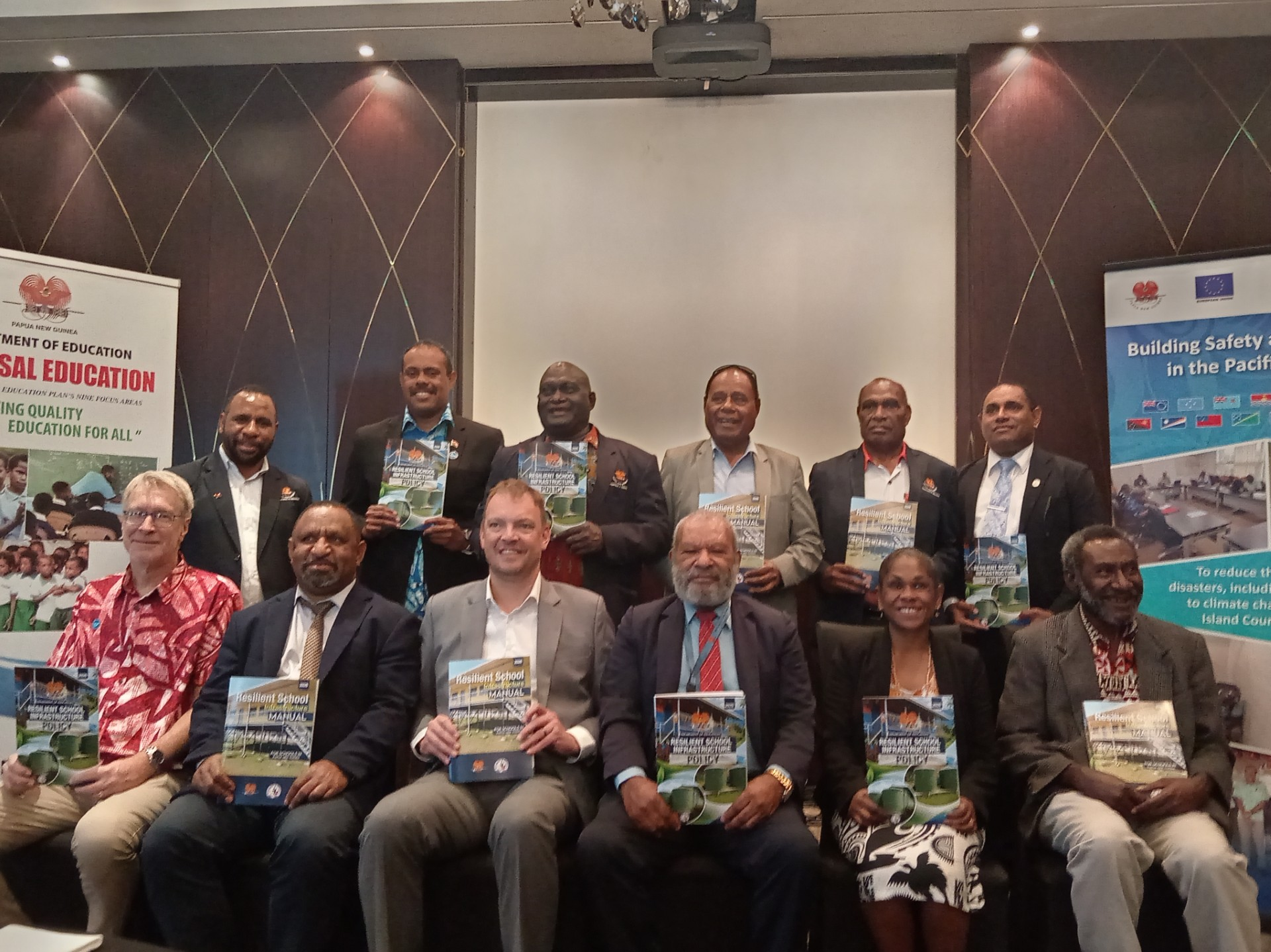
Papua New Guinea's new Resilient School Infrastructure Policy is seeking to change how schools are planned, built, and maintained, with stronger standards for dealing with natural disasters and climate-related risks.
Walipe Wingi, Deputy Secretary for Schools and Standards, said the policy provides a framework covering the entire infrastructure cycle-from planning and design to construction, maintenance and management.
Speaking on behalf of Education Secretary Dr. Uke Kombra, Wingi said that resilient infrastructure is fundamental to quality education as schools must provide safe, secure, healthy, inclusive and accessible environments for students, teachers, administrators and communities.
“The policy provides a framework for strengthening the planning, design, construction, maintenance, and management of school infrastructure," said Mr. Wingi. “So that the schools can continue to provide quality learning environments, even in the face of natural hazards, climate change, and other risks.”
However, Wingi stated that standardization would not mean every school would necessarily look the same.
“Standard designs should be acceptable and adaptable to different geographical, environmental, cultural, and community contexts throughout Papua New Guinea.”
“This is particularly important in a country where schools face different disaster risks depending on their location,” he added.
He identified earthquakes, floods, landslides, and cyclones among the hazards school infrastructure must be able to withstand, and in addition the policy also places emphasis on water and sanitation, hygiene, security, accessibility, and the wellbeing of school communities.
Facilities for people with disabilities and gender-responsive infrastructure are also included.
“You do not want to build classrooms up on the stilts when the majority of students nearby are disabled.”
Therefore, Wingi stressed that resilient infrastructure could not be achieved through construction alone.
He said coordinated planning, adequate budgeting and regular maintenance; rehabilitation and assessment, would be required at national, provincial, and local levels.
Meanwhile, the PNG National Disaster Centre's Director Laso Mana, said the policy should also be viewed from a disaster preparedness perspective.
Maso said schools capable of withstanding disasters could become places of shelter and safety for communities during emergencies.
He cited the current El Niño situation and drought as reminders of the country's exposure to disasters and the importance of stronger preparedness.
“A school built to withstand a cyclone, an earthquake, or a drought is not only a place for learning; in many of our communities, it has become a place of shelter and safety when disasters strike.”
For the European Union, however, the key question now is how the policy will be implemented.
Dr. Hans Lambert, Head of Cooperation with the European Union Delegation to PNG, urged the Education Department to work with the Department of National Planning and Monitoring to develop a costed implementation plan.
He also called for clear timelines and funding to ensure the policy moves from paper into practice.