

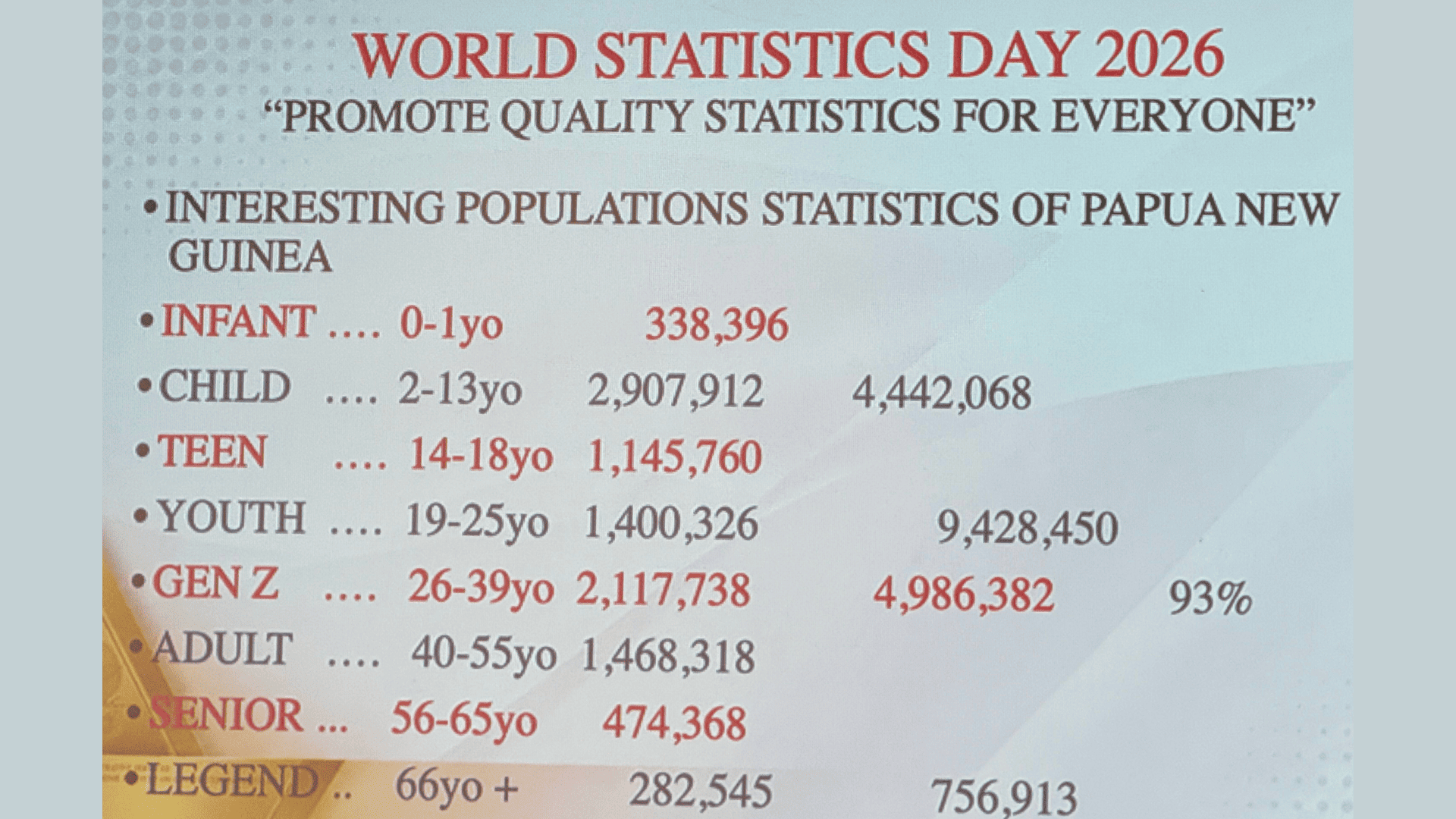
Youths in the country, particularly Generation Z (Gen Z) and younger populace, make up 93 per cent of our country’s biggest population.
This is according to the 2024 Census figures revealing a nation dominated by Children, teenagers and young adults.
The figures have revealed that in fact, Papua New Guinea is a young nation, and its future will largely depend on how well the government invests in its younger generation.
According to the 2024 Census population statistics presented by Minister for Administrative Services and Minister Assisting the Prime Minister on Constitutional Matters, Richard Masere.
Mr Masere presented that PNG recorded more than 10 million people in the 2024 Census, compared to 2.8 million at independence in 1975.
Breaking down the population, the figures show that approximately 338,000 are infants, 2.9 million are children aged between two and 13, while more than 1.1 million are teenagers aged between 14 and 18.
Together, these groups account for approximately 4.4 million people.
The young adult population is also significant, with approximately 1.4 million people aged between 19 and 25, while another 2.1 million are aged between 26 and 39.
This means millions of Papua New Guineans are entering or already within the ages when they should be studying, building careers, starting businesses, raising families and contributing to the economy.
Masere warned that this growing young population could become either the country's greatest asset or its greatest liability if the Government fails to plan for their future.
"Our young generation can be our greatest asset, or they can be our greatest liability," he said.
He challenged the Government to take the population figures seriously when planning national development, particularly in education, employment, healthcare and essential services.
The statistics also highlight the need to understand where young people are moving.
Masere pointed to growing domestic migration, particularly towards Port Moresby, where the population has increased to just under 800,000, compared with just under 300,000 recorded in 2011.
He said some provinces were recording much slower population growth, partly because young people were moving away in search of opportunities in urban centres.
For example, Manus was projected to have approximately 89,000 people, but the 2024 Census recorded only about 69,000.
The movement of people into cities is creating greater pressure on electricity, water, roads, schools and hospitals.
Masere said the National Statistical Office needed to strengthen the collection of domestic migration data to help the Government understand where people were moving and plan services accordingly.
For PNG's Gen Z and younger population, the numbers raise an important question: will the country create enough opportunities for the millions of young people who will shape its future?
Masere said PNG's biggest resource is not only beneath its ground, in its forests or in its seas.
Its people, particularly its young generation, are also a major national asset.