
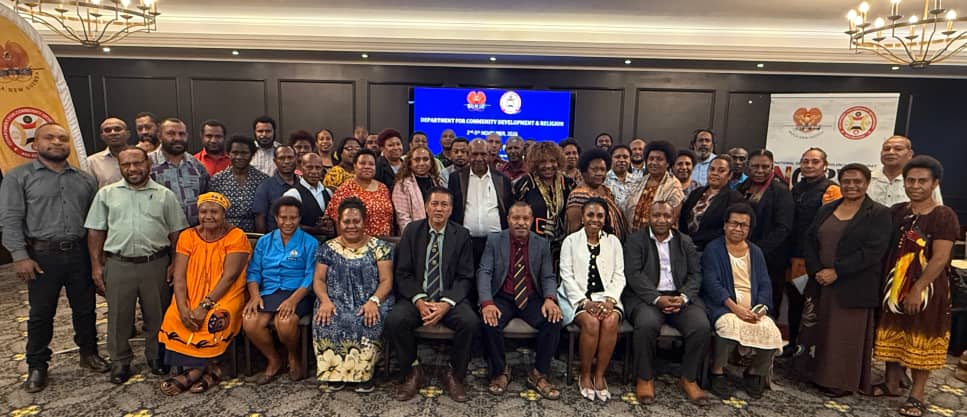
A three-day Gender Base Violence Workplan Plenary Workshop is underway today in Port Moresby at the Airways Hotel.
The workshop brought in equal representation from all twenty-two provinces. GBV provincial focal points and coordinators from key functions within Provincial Administrations will be sharing updates on their 2026 workplan implementation, while contributing toward the formulation of Provincial GBV Action Plan for 2027.
Speaking to the participants before declaring the Plenary workshop open, Deputy Secretary of the Department for Community Development and Religion, Mr. Jack Simbou said a coordinated approach across all levels is the Department's focus through the National GBV Policy working in line with the Integrated Community Development Bill.
Mr. Simbou thanked the provincial coordinators and representatives for attending this important workshop as this is one avenue where they can share and contribute towards recommendations that will help with their planning to address GBV issues in the country.
He emphasized on the importance of addressing the root causes of GBV through collaborative efforts with government agencies, Civil Society Organisations, Non-government Organisations, Stakeholders and key partners to achieve a zero-tolerance goal as per the MTDP.
And to achieve that is to create workable and effective mechanisms within the systems, which the department and the GBV Secretariat had already in place.
National GBV Secretariat Executive Director Ms. Dianne Kambanei says stronger provincial capacity and access to survivor services are central to the national strategy.
Papua New Guinea is strengthening its national response to gender-based violence (GBV), with a goal of achieving zero tolerance by 2050.
Ms. Kambanei outlined progress on the national strategy, including its endorsement in December and its launch by the Prime Minister on March 11.
PNG’s approach has attracted international interest. At a global GBV research conference, representatives from countries including Malawi expressed interest in the country’s commitment to dedicating parliamentary time to GBV discussions, she said.
The strategy’s vision is a Papua New Guinea free from violence and discrimination. Its mission brings together survivor-centred services, accountability, cultural change, legal reform and collaboration across sectors. Addressing low conviction rates through legal reforms is among the priorities identified.
Ms. Kambanei said provincial capacity is essential to putting the strategy into practice. The Secretariat considers a provincial GBV secretariat “functioning” if it has at least five staff members and dedicated funding. Currently, only four provinces—National Capital District, Simbu, Western Highlands and Jiwaka—meet the five-staff threshold.
The National Secretariat is encouraging provincial administrators to reallocate existing staff or secure funding to meet the requirements.
The strategy also aims to make survivor services more accessible in rural areas, with a target of 60 per cent rural access. Services are intended to reach communities at district level, rather than relying mainly on urban safe houses.
The second plenary workshop will end on Wednesday, November 4th, 2026.