
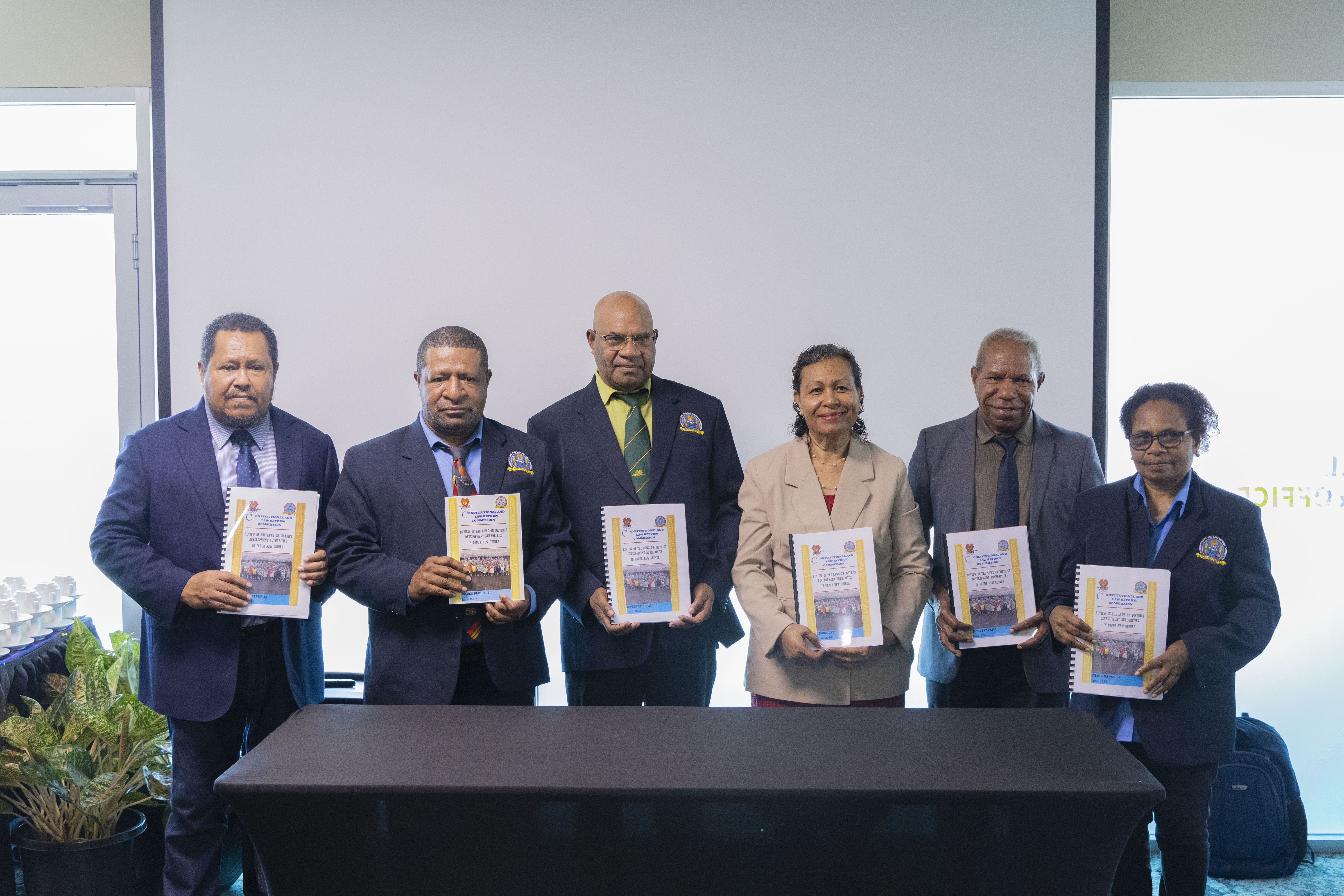
The Constitutional and Law Reform Commission (CLRC) has officially launched the Issues Paper for Terms of Reference (TOR) No. 26 – Review of the Laws on the District Development Authorities (DDAs).
This launch marks the official commencement of a nationwide review examining the legislative framework that governs DDAs across Papua New Guinea.
By outlining the current enabling laws, identifying key operational challenges, and presenting targeted questions, the Issues Paper serves as the foundation for upcoming public consultations aimed at encouraging informed discussions among stakeholders and the wider public.
Endorsed and gazette by the Minister for Justice and Attorney General early this year, TOR 26 explicitly tasks the CLRC with inquiring into, reporting on, and recommending systemic development and reforms for PNG’s DDA laws.
To ensure its ultimate proposals are both extensive and inclusive, the Commission is reviewing all key pieces of legislation connected to district administration.
While Papua New Guinea's decentralized system of government was originally restructured under the Organic Law on Provincial Governments and Local-level Governments in 1995, the specific DDA Act was enacted later in 2014 to strengthen district-level service delivery.
The Act has undergone various amendments since then, reflecting continuous efforts to improve local governance and effectiveness.
However, following long-standing controversies surrounding the actual performance of DDAs, the CLRC conducted pre-stakeholder engagements alongside comprehensive desktop research to evaluate their true efficacy.
The newly launched Issues Paper is the direct culmination of those preliminary discussions and research efforts.
Ultimately, TOR 26 aims to determine whether existing laws still effectively support service delivery, accountability, transparency, and good governance in alignment with the nation’s evolving development priorities.
Speaking at the launch, CLRC Commissioner Hon. Isi Henry Leonard highlighted the profound importance of the review and underscored the Commission's core mandate in executing this responsibility.
“Where gaps, inconsistencies or weaknesses exist within the current legal framework, it is incumbent upon the Constitutional and Law Reform Commission, as the nation’s mandated law reform agency, to thoroughly investigate these issues and formulate appropriate law reform proposals to strengthen the DDA system.”
He further noted that the review presents a vital opportunity for all stakeholders to contribute toward reinforcing the legal framework for improved service delivery and sustainable development.
“However, CLRC cannot undertake this important task in isolation.”
“Meaningful and lasting reform can only be achieved through broad-based consultation and collaboration with government agencies, provincial administrations, district authorities, civil society organizations, development partners and, most importantly, our people.”
In light of this, the Commission is actively encouraging government agencies, provincial administrations, district authorities, civil society organizations, development partners, and members of the general public to participate in the consultation process by sharing their views and recommendations.
As the next step in its established law reform process, the CLRC will soon commence provincial consultations to gauge the perspectives of citizens nationwide, ensuring that its final recommendations regarding TOR 26 are comprehensive, practical, and highly applicable in contemporary Papua New Guinea.