

POSTS BY AUTHOR

PNG Haus Bung
 THAILAND TO REOPEN FOR SOME VACCINATED VISITORS ON 1 NOVEMBER
Thailand plans to end Covid quarantine requirements for fully vaccinated travellers from at least 10 low-risk nations from 1 November, officials say.
PM Prayuth Chan-ocha admitted that "this decision comes with some risk" - but it is seen as a key step to revive the country's collapsed tourism sector.
The 10 nations seen as low risk include the UK, China, Germany and the US.
The country has been recording more than 10,000 positive infections daily since July.
It has fully vaccinated around 33% of its almost 70 million people. Half the population has received one dose.
Mr Prayuth said Thailand would also allow entertainment venues to reopen on 1 December and permit alcohol sales.
He added that the authorities were planning to open Thailand for more countries on that date.
Mr Prayuth's comments came in a televised address on Monday.
Referring to visitors from 10 low-risk nations, he stressed that "when they arrive, they should present a [negative] Covid test... and test once again upon arrival".
If the second test is also negative, any visitor from those countries "can travel freely like Thais", the prime minister said.
But he warned that the government would act decisively if there were to be a spike in infections or an emergence of a highly contagious variant of Covid-19.
It is estimated that Thailand - popular for its sandy beaches and non-stop nightlife - lost about $50bn (£37bn) in tourism revenue in 2020.
The economy suffered its deepest contraction in more than two decades as a result of the pandemic.
Published on October 12, 2021
 INDIA WILL BAN SINGLE-USE PLASTICS NEXT YEAR TO CUT POLLUTION — EXPERTS SAY THAT’S NOT ENOUGH
India will ban most single-use plastics by next year as part of its efforts to reduce pollution — but experts say the move is only a first step to mitigate the environmental impact.
India’s central government announced the ban in August this year, following its 2019 resolution to address plastic pollution in the country. The ban on most single-use plastics will take effect from July 1, 2022.
Enforcement is key for the ban to be effective, environmental activists told CNBC. New Delhi also needs to address important structural issues such as policies to regulate the use of plastic alternatives, improve recycling and have better waste segregation management, they said.
Single-use plastics refer to disposable items like grocery bags, food packaging, bottles and straws that are used only once before they are thrown away, or sometimes recycled.
“They have to strengthen their systems in the ground to ensure compliance, ensure that there is an enforcement of this notification across the industry and across various stakeholders,” Swati Singh Sambyal, a New Delhi-based independent waste management expert told CNBC.
Why plastics?
As plastic is cheap, lightweight and easy to produce, it has led to a production boom over the last century, and the trend is expected to continue in the coming decades, according to the United Nations.
But countries are now struggling with managing the amount of plastic waste they have generated.
About 60% of plastic waste in India is collected — that means the remaining 40% or 10,376 tons remain uncollected, according to Anoop Srivastava, director of Foundation for Campaign Against Plastic Pollution, a non-profit organization advocating for policy changes to tackle plastic waste in India.
Independent waste-pickers typically collect plastic waste from households or landfills to sell them at recycling centers or plastic manufacturers for a small fee.
However, a lot of the plastics used in India have low economic value and are not collected for recycling, according to Suneel Pandey, director of environment and waste management at The Energy and Resources Institute (Teri) in New Delhi.
In turn, they become a common source of air and water pollution, he told CNBC.
Banning plastics is not enough
Countries, including India, are taking steps to reduce plastic use by promoting the use of biodegradable alternatives that are relatively less harmful to the environment.
For example, food vendors, restaurant chains and some local businesses have started adopting biodegradable cutlery and cloth or paper bags.
However, there is currently “no guideline in place for alternatives to plastics,” Sambyal said.
That could be a problem when the plastic ban takes effect.
[caption id="attachment_15939" align="aligncenter" width="952"] A machine picking up waste in the pile of garbage at the Ghazipur land fill site where city’s daily waste has been dumped for last 35 years. The machine separates waste into three parts first stone and heavy concrete material second plastic, polythene and third is fertilizer and soils.Pradeep Gaur | SOPA Images | LightRocket | Getty Images[/caption]
Sambyal said clear rules are needed to promote alternative options, which are expected to become commonplace in future.
The new rules also lack guidelines on recycling.
Though around 60% of India’s plastic waste is recycled, experts worry that too much of it is due to “downcycling.” That refers to a process where high-quality plastics are recycled into new plastics of lower quality — such as plastic bottles being turned to polyester for clothing.
“Downcycling decreases the life of the plastic. In its normal course, plastic can be recycled seven to eight times before it goes to an incineration plant ... but if you downcycle, after one or two lives itself, it will have to be disposed,” said Pandey from Teri.
[caption id="attachment_15940" align="aligncenter" width="954"] In India’s state of Maharashtra, people are seen carrying bags of other materials, mostly cotton for their daily routine and shopping on June 24, 2018 in Pune, India.Rahul Raut | Hindustan Times | Getty Images[/caption]
Tackling waste segregation is also essential.
If general waste and biodegradable cutlery are disposed together, it defeats the purpose of using plastic alternatives, according to Sambyal.
“It is high time that source segregation of domestic waste is implemented vigorously,” said Foundation for Campaign Against Plastic Pollution’s Srivastava, referring to waste management laws that are in place, but not followed closely.
Way forward
Environmentalists generally agree that the ban is not sufficient on its own and needs to be supported by other initiatives and government regulations.
The amount of plastic that is collected and recycled needs to be improved. That comes from regulating manufacturers and asking them to clearly mark the type of plastic used in a product, so it can be recycled appropriately, said Pandey.
[caption id="attachment_15941" align="aligncenter" width="951"] A women rag picker collecting plastic bottle and other plastic materials in a boat from the bank of Brahmaputra River in Guwahati, Assam, India on Monday, October 29, 2018.David Talukdar | NurPhoto | Getty Images[/caption]
In addition to improving recyclability, investment in research and development for alternatives should also be a priority.
Pandey explained that India is a big, price-sensitive market where plastic alternatives could be produced in bulk and sold at affordable prices.
Several Indian states introduced various restrictions on plastic bags and cutleries in the past, but most of them were not enforced strictly.
Still, the latest ban is a big step toward India’s fight against landfill, marine and air pollution — and is in line with its broader environmental agenda, according to the experts.
In March, India said it was on track to meet its Paris agreement climate change targets, and added that it has voluntarily committed to reducing greenhouse gas emission intensity of its GDP by 33% to 35% by 2030.
SOURCE: CNBC NEWS
Published on October 12, 2021
 SECOND PANTHER TO BE QUESTIONED BY NRL OVER BORDER BREACH
The NRL Integrity Unit will interview Panthers stars Nathan Cleary and Tyrone May over three men who crossed the Queensland border with illegal work permits to attend the Grand Final.
The Sydney Morning Herald reported the three men gained access to an area in proximity to the Panthers players friends and family at Suncorp Stadium on October 3.
The development comes as Panthers great Greg Alexander told some Penrith players to pull their heads in over some distasteful social media posts during their wild premiership celebrations.
While Alexander didn’t name names the inference was that he was referring to Tyrone May, who painted himself as the victim of his well publicised sex tape scandal with an Instagram post showing a photo of him leaving court last year.
This despite the fact May pleaded guilty to four counts of intentionally recording an intimate image without consent with the magistrate saying at the time that he was lucky to avoid jail time.
May has since deleted the social media post.
“There have been a couple of social media things that haven’t impressed me,” Alexander said on SEN radio.
“I think a couple of our players need to pull their heads in after what they’ve posted on social media. It gets a bit out of control. I don’t follow social media.
“I’ve had people tell me about what’s been posted, and some of it shouldn’t have been. It was a bit out of line.”
In the case of the Queensland border breach the NRL Integrity Unit are trying to ascertain how the three men gained access to an area of Suncorp Stadium reserved for family and friends of players.
The three men in question were fined $4,135 by Queensland Police over the breach.
At this stage there is no suggestion May or Cleary knew the three men had breached public health orders or that they would be at the NRL Grand Final.
The NRL will conduct their interviews with May and Cleary on Tuesday.
Published on October 12, 2021
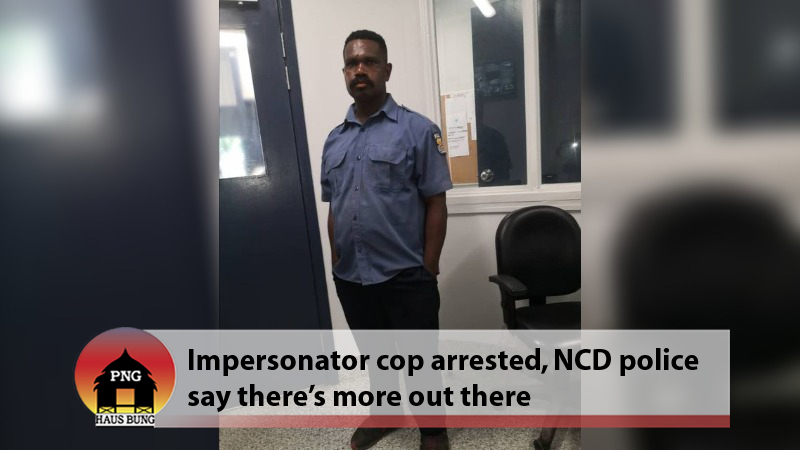 POLICE IMPERSONATOR ARRESTED AND CHARGED
A man has been arrested and charged for impersonating a member of the Royal Papua New Guinea Constabulary.
He was apprehended on Saturday 09th of October 2021, after NCD Metropolitan Superintendent came across him at the Gerehu Shopping Centre.
Superintendent Ikumu, had approached the impersonator, demanding why he was scruffy in uniform and conducting himself unprofessionally in a supermarket. Superintendent Gideon Ikumu realised something was not right, when the man didn't know who was speaking to him.
He was apprehended by Waigani Police who were close by and were first to respond. Police personnel confirmed that the man was an impersonator.
He was taken to Waigani Police Station, where he was formally arrested and charged.
The Police uniform was removed from him and will be used as exhibit in Court.
He has identified himself to be Israel Badui of East Sepik.
He has never undertaken any formal police training and is not a Police Reservist.
We call on members of the community who may have at one time been dealt with by this person, to report any of the incidents if any to Waigani Police Station.
Internal Investigations will ascertain as to how he and for how long he has been impersonating to be a member of the RPNGC and if any regular members of the Constabulary have been entertaining him.
Divisional Commander NCD/Central Assistant Commissioner Anthony Wagambie Jnr stated that there are reports of more impersonators within NCD and Central, and work is being done to identify and arrest them.
Photo of Police Impersonator Israel Badui
Story source: Police - NCD/Central Command
Published on October 12, 2021
 KOPKOP COLLEGE GRADE 10’S SIT FOR NATIONAL EXAMINATION
Grade 10 students at a permitted private school, kickstarted this week’s National Exam, with their Math and Personal Development papers today, joining more than 70,000 Grade 10s in both private and public schools.
Deputy Principal Ms. Rogana Pawai said Kopkop College’s registered status amongst 57 other private schools in NCD, gives them this opportunity to oversee the National Examination similarly to any other government-run schools in PNG.
The exam papers were handed by the Measurement Services Division to all school principals in NCD last Thursday, while an external invigilator is now present at the school to monitor during this week’s exam.
Amidst this challenging time, Ms. Pawai advises all Grade 10’s, “Do not enter an exam room with doubt but be confident in your thoughts knowing that you can and you will do it. When you allow doubt to creep in you are likely to deter your judgement.”
Kopkop College has performed well in previous years’ examinations of which a good number of its students continue to be chosen under the top five category to attend the National High Schools including Port Moresby, Sogeri, Passam, Aiyura and Keravat National High Schools.
“Again, this year we are very confident with our current Grade 10’s and are expecting some good results from them,” she added.
Following on from last years’ experience, Ms. Pawai believes their teachers have certainly learnt lessons from COVID-19 and have settled into a new way of managing their time and coming up with creative ways to cover lessons.
“For us teachers it has been very challenging. The lockdown ripped us from our teaching time. We have never faced this before. When COVID came in we had to readjust and complete the exams in time.”
“Our teachers have done well and there’s no topic that wasn’t covered. COVID made us realize that emergencies are bound to happen and moving forward we are now more prepared. Whatever else comes our way be it Covid or other we are now more than ready. “
Kopkop College, a permitted private school which offers classes from Day-Care to Grade 12, continues to follow its strict KC C-19 Protocol as this week’s exam similarly saw strict health measures put in place.
The Department of Education has since notified all schools of the exam procedures and appealed for strict compliance. They include: strict administering of exam timing by external invigilator, penalty on cheating, malpractices must be reported immediately by responsible authorities and ban on all mobile phones.
Published on October 11, 2021
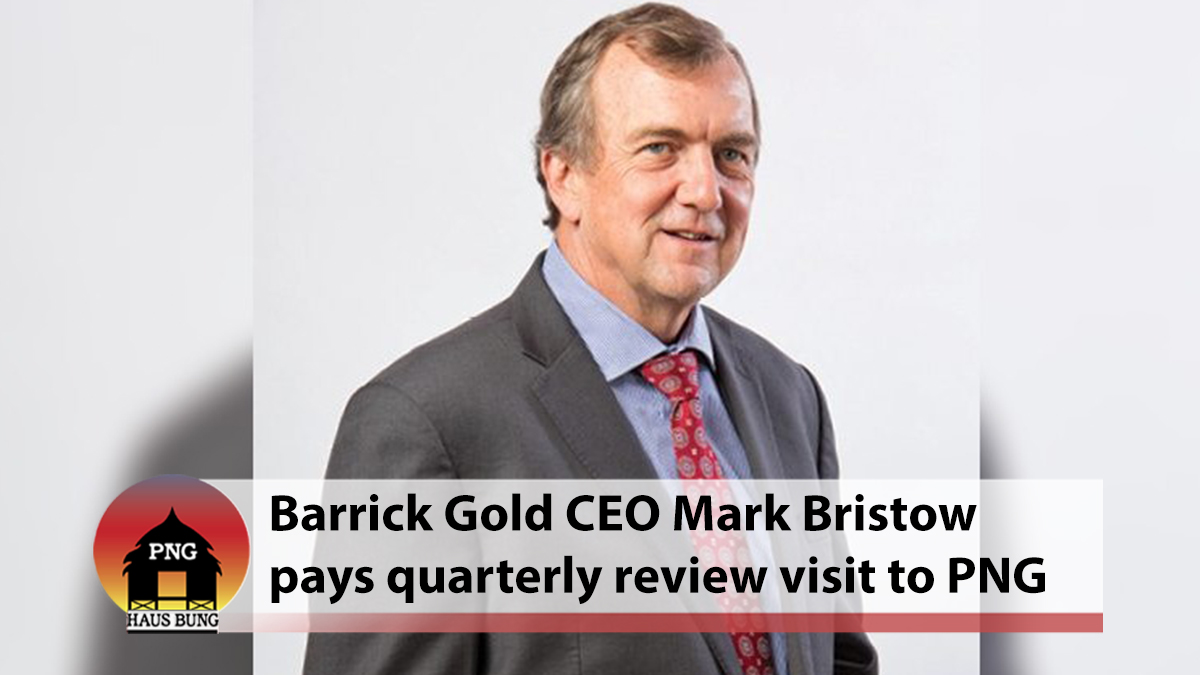 BARRICK GOLD CEO BRISTOW BACK IN PNG
Barrick Gold CEO and President Mark Bristow will be in Papua New Guinea from 12th to 15th of October along with senior Barrick Gold executives, as a part of their quarterly review visits to Barrick operated mine sites throughout the world.
Dr Bristow is expected to meet with Prime Minister James Marape and senior PNG Government officials during his visit.
While the Porgera Mine is presently under care and maintenance, negotiations for the re-commencement of mining at Porgera continue, in line with the terms of the Framework Agreement signed between Barrick and the State in April of this year.
Dr Bristow has stated that he hopes that his visit will assist in progressing negotiations past certain critical milestones and that all key agreements required prior to the re-commencement of mining will be signed soon.
He further noted that Barrick remains entirely committed to restarting the Porgera Mine under the terms of the Framework Agreement.
He reiterated his view that all parties need to be conscious of the passage of time and should work together to finalize negotiations at as soon as possible to ensure an expedient mine restart. This would ensure that the Porgera Mine can start contributing to Papua New Guinea’s economic recovery impacted by the COVID-19 pandemic.
“While the current pace of the negotiations is not as rapid as we might have hoped, certain commercial arrangements, as defined under the Framework Agreement, need to be finalized to give our shareholders confidence in the reinvestment,” Dr Bristow said.
“I sincerely hope we can get these agreements signed off by the State as soon as possible, particularly given the ongoing cost of keeping the mine under care and maintenance.
“We all need to put in our best efforts towards concluding the remaining agreements if we want to have any chance of restarting the mine this year or early next year,” he said.
Barrick Niugini Limited management have previously noted that should a final agreement be reached between BNL and the Government of Papua New Guinea regarding the recommencement of operations at Porgera, any information regarding recruiting processes to be undertaken by BNL will be published on official BNL websites, social-media sites and via company statements.
Published on October 11, 2021
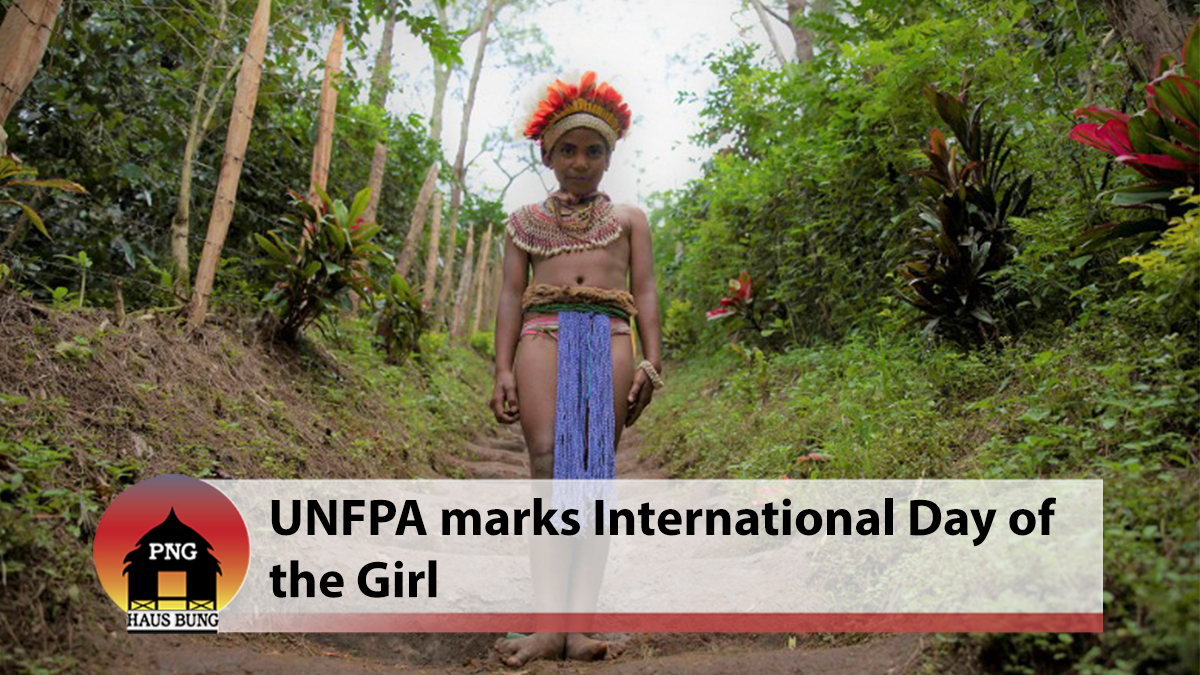 UNFPA MARKS INTERNATIONAL DAY OF THE GIRL 2021
Girls are born with power. Every girl has within her possibilities that should flourish as she moves into adulthood, shaping her future and, with it, the world.
We see examples of this everywhere, in the girls at the vanguard of movements calling for climate justice, universal education and more. The transformative imprint of incredible women – those whose potential was fulfilled – is visible everywhere, from legislation to life-saving vaccines to the frontiers of technology.
But there are so many girls in the world whose inherent power is unrealized. Their rights are denied, their choices and chance to thrive are undermined. As a result, we all miss out on what these girls could achieve, on the gifts their vision, ingenuity and passion could offer the world.
Today, as we mark the International Day of the Girl, we celebrate girls in the digital generation. They are harnessing the power of new technologies to carve out a better future for all. Yet as we do so, we must also call urgent attention to those left behind by gender discrimination that systematically limits girls, now and across their lifetimes. These inequalities extend to the Internet, which girls still use less than boys – up to four times less in some countries. This digital divide compounds longstanding gender disparities.
The COVID-19 pandemic has shown how quickly inequalities can multiply: Under school closures, girls who lack Internet access have seen losses in education, health information and care. In many places, girls denied an education face an increased risk of being married off against their will. The realization of many rights is increasingly predicated on digital access, which can help girls find information, connect with peers, build social movements, explore their identities, track their periods and find help for harassment or violence.
Without such access, girls face major barriers to achieving their sexual and reproductive health and rights and bodily autonomy. Those in a refugee camp or poor community may have no options for nearby services that respond to their sexual and reproductive health needs with kindness and understanding. The shame or embarrassment they may feel in asking questions about sex or gender identity is more readily overcome in the anonymity of the online world.
Digital technologies have their downsides, of course. Girls with access to these technologies face mounting risks from various forms of cyberviolence. Access for girls with disabilities remains insufficient, and local language availability is far too limited. These issues, too, reflect harmful gender power imbalances.
We must not tolerate a digital world that reinforces inequality. Instead, let’s use these tools to close the gender power gap for girls. We can do this through projects like Mandukhai, a new chatbot developed by UNFPA to reach Mongolian adolescents with accurate sexual and reproductive health information. Let’s apply these technologies to help girls achieve their rights and secure their bodily autonomy. This is what happened when a young woman in India used the information provided by a UNFPA-supported mobile ‘edutainment’ service to save a friend from child marriage.
Girls aren’t just using these tools; they are creating them. Let’s support them. UNFPA has teamed up with private sector partners in a number of countries to provide the mentorship and resources girls need to design innovative digital solutions for a more equal future.
Together, let’s create a digital world that is accessible and safe for all, and build a future in which every girl is able to realize her full potential and power.
Published on October 11, 2021
 SOPER LOOKING FORWARD TO CRICKET WORLD CUP
‘Cricket has given me a drive and I’ve realized my passion. I love cricket and I love working with kids.’
Based in Australia, this jovial chap from Samarai (Milne Bay Province, PNG) and New Zealand knows what his purpose is. Chad already couples his passion of cricket and teaching Australia where he coaches kids at a private school and does one-on-one training. It’s the path he’s decided to take after his retirement from professional cricket.
The 29-year-old all-rounder says cricket has taught him patience and willpower. Apart from other skills that the sport teaches, it’s mostly mental skills and that’s something he’s learnt throughout his career. He adds, ‘It’s been an amazing journey! I get to meet new friends. It’s funny, I was just looking through my passport and realized how many countries cricket has taken me to.’
It all started as a fun game with his dad at around the age of seven, with sloppy bowling skills in his white school shorts. Fast forward to 2012, Chad made the PNG U19 team, and then making the Barras three years later. Former Australian international cricketer, Andrew Symonds and New Zealand international cricketer, Ross Taylor were two men he looked up to growing up. Watching how exceptional they played and finding commonalities about their backgrounds inspired him.
With the games Kumul Petroleum PNG Barramundis have played over the years, he knows that the boys can win. ‘The same core group who played four or five years ago and won those ODI tournaments are still here. We just need more match practice,’ he says. Commenting on the recent ODI tournaments, Chad says, ‘It’s pretty disappointing but the boys can do better. We just have to play smarter and be fearless. We know that we can turn things around.’
In his down time, Chad loves surfing, playing the guitar and listening to good music. Rooting for his Kiwi artists, he loves anything from Six60 and L.A.B (right now it’s In the Air), with some Afrobeats added to his playlist. He’s also got an eye for photography; something he enjoys a lot.
Currently in Dubai with the Barras, Chad remains positive about the team’s performance in the World Cup. He is trusting in one of his favourite bible verses, Philippians 4:13 “I can do all things through Christ who strengthens me.”
Published on October 11, 2021
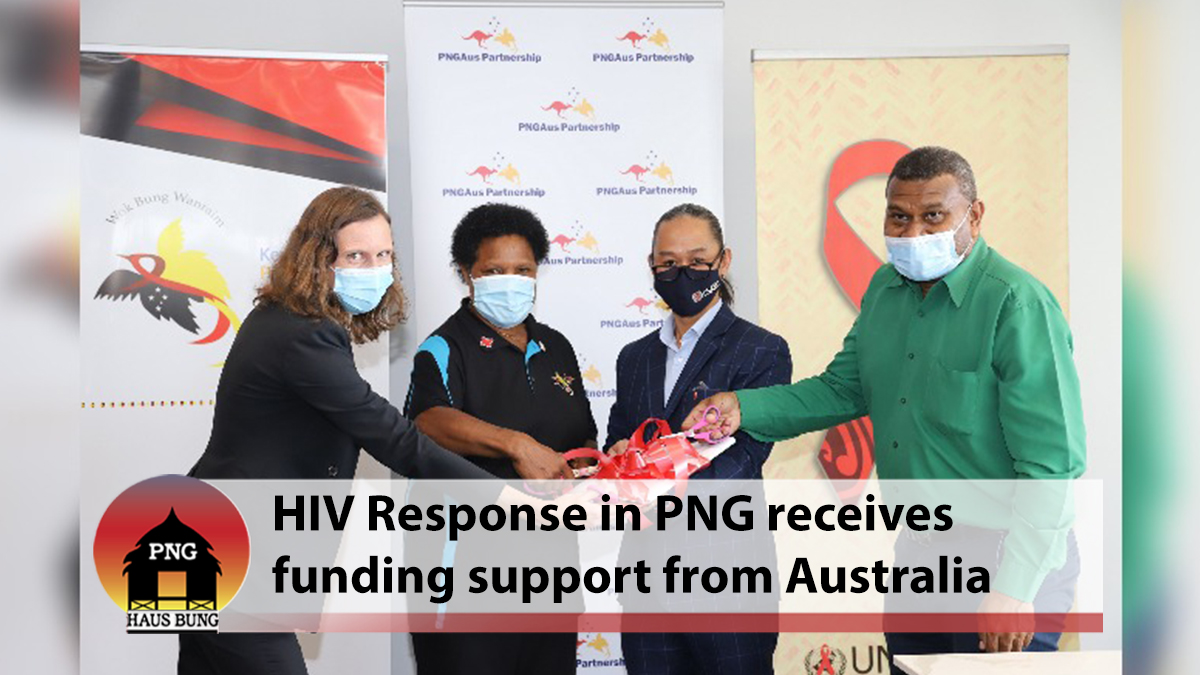 AUSTRALIA PROVIDES FUNDING FOR HIV RESPONSE IN PAPUA NEW GUINEA
Australia is partnering with UNAIDS and the PNG National Department of Health to deliver a PGK3.8 million investment to prevent HIV transmission and support people living with HIV in Papua New Guinea.
The goal of this investment is to reverse the annual increase of HIV among key populations through a focus on three key areas: improved policy, legal and regulatory environments, strengthening the role of community-led organisations, and provision of accessible HIV prevention, testing and treatment services.
The new investment was officially launched in Port Moresby on Friday 01 October by representatives from UNAIDS and of the governments of PNG and Australia. The grant will be delivered by UNAIDS PNG and the PNG National HIV Program.
This program forms part of Australia’s support to the Global Fund to fight AIDS, Tuberculosis and Malaria. Australia is contributing AUD242million (PGK619million) to the fund in 2021-2023, to support global efforts to defeat HIV, TB, malaria and COVID-19.
Australia is committed to working with development partners to deliver essential health services, including for HIV, to protect the health of citizens in the region. This new funding is in addition to our support for HIV testing and treatment through Catholic Church Health Services, including providing antiretroviral therapy for nearly 4000 people in 11 provinces.
Minister Counsellor, Diane Barclay of the Australian High Commission said, “Australia is committed to assisting people at risk of or living with HIV/AIDS. We are pleased to partner with UNAIDS and the National Department of Health to increase the availability and uptake of HIV prevention, testing and treatment services.
By working closely with community-led organisations, we can ensure that services provided are targeted, appropriate and accessible to populations at risk of, or living with HIV.”
“UNAIDS welcomes this added investment from Australia for the region and especially here in Papua New Guinea. It comes at a critical time as we face the colliding pandemics of HIV and COVID-19."
"Now more than ever we need to ensure that community- based and community-led services are firmly in place and supported if we are to end AIDS and respond to emerging pandemics going forward."
"UNAIDS in partnership with the Government, the community representing key populations and our development partners will work to ensure these resources strengthen community responses and in turn accelerate our response to HIV here in Papua New Guinea, ” said David Bridger, UNAIDS PNG Country Director.
In support of the initiatives launch Dr Penial Boas, PNG National HIV Program Manager remarked, “We can end AIDS here in Papua New Guinea, but we will need to regain our momentum to achieve this, and we will need a broad and inclusive partnership to go further.”
Dr Boas concluded by saying, “The support outlined today by our colleagues and partners is all about rebuilding that momentum.”
“The DFAT funding has come in a timely manner that will increase investment in our public health but with a focus on our vulnerable communities who are most at risk in Papua New Guinea."
"This funding will support a new way of working with Key Population by investing on a tool called Community Led Monitoring (CLM),” said Cathy Ketepa, Chairperson, KP Consortium
Published on October 11, 2021
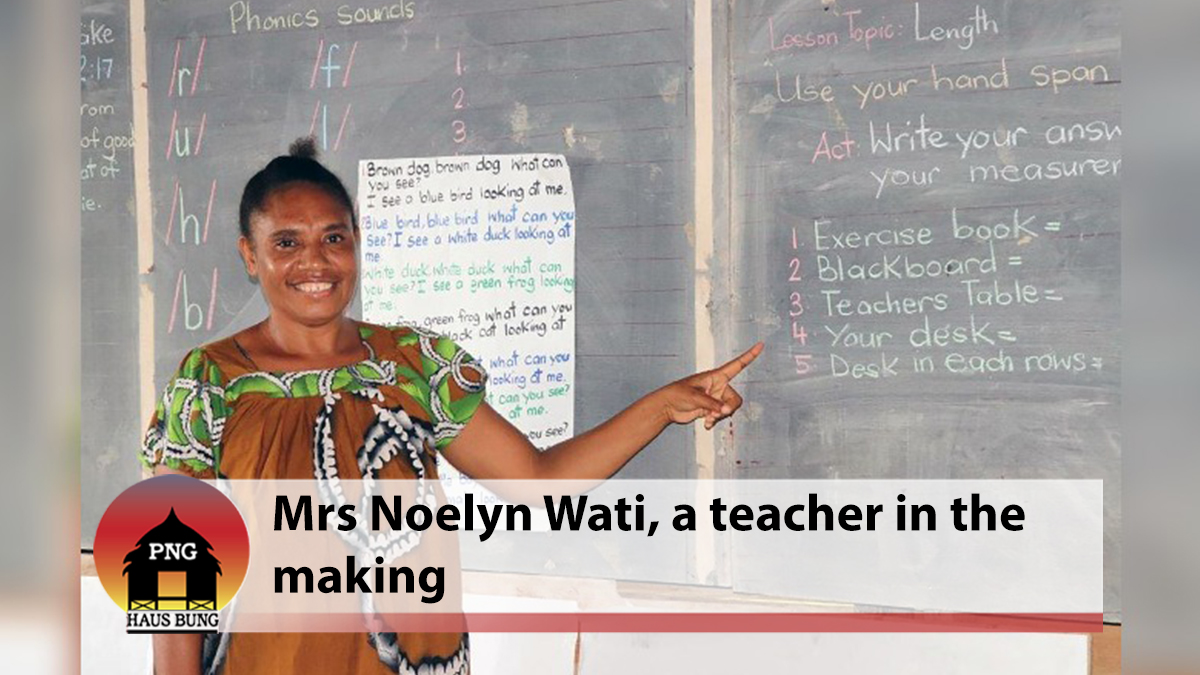 VOLUNTEER TEACHER PUTS HER HEART INTO KOKODA TRACK EDUCATION
After her husband passed away in 2015, Noelyn Wati decided to become a teacher. Teaching was one way for the 40-year-old to support her children and others in the Kokoda Track region of Central Province, and to help her and her family cope with the loss.
She took up short courses through the Seventh Day Adventist community-based program, and in 2018 started as a volunteer at Bisiatabu Primary School in Sogeri.
“I always encouraged my eldest son to continue his studies when he lost hope after the death of his father,” Noelyn recalled. “but I felt I had to do more than just stay at home and talk.”
“The short courses helped me to understand the basics of teaching elementary students and I enjoy seeing them learn and grow which also gives me confidence to grow in this profession.”
Noelyn wanted to continue learning to improve as a teacher. In 2019 she received a scholarship, through the Kokoda Initiative, to access flexible, open and distance education (FODE) to achieve her high school qualifications.
Australia, through the Kokoda Initiative, has supported forty teachers and health workers in the Kokoda Track region to undertake alternative education pathways like FODE.
When the PNG Government’s 1-6-6 schooling structure comes into place, teachers will need formal education qualifications and Noelyn is prepared to take on that challenge and become a fully-fledged teacher like her two older siblings.
She completed her grades 10 and 11 qualifications at the Kokoda Track Foundation FODE College in Northern Province, and is now studying for grade 12 at the FODE centre in Port Moresby.
In 2022, Noelyn expects to be one of the 17 FODE students – teachers, health workers and village health volunteers – to graduate from year 12.
“I am so determined to do well to achieve an official position as a teacher listed in the National Education System,” she said.
In her current teaching role, she is benefiting from other Kokoda Initiative support to her education, including teacher in-service training and work to strengthen school governance which are providing a boost to teaching quality and student learning outcomes.
Noelyn was among a group of 30 elementary teachers who recently completed phonics modules as part of their school in-service training this year to improve literacy lesson planning and student learning.
Through the Kokoda Initiative, Australia supports more than 200 teachers at 19 primary schools and 41 elementary schools across the Kokoda Track region.
The Kokoda Initiative in partnership with Central and Northern Provincial education authorities also supports school inspections, teacher assessments and provision of standards-based curricula to schools to ensure the quality of teaching and learning.
Published on October 11, 2021
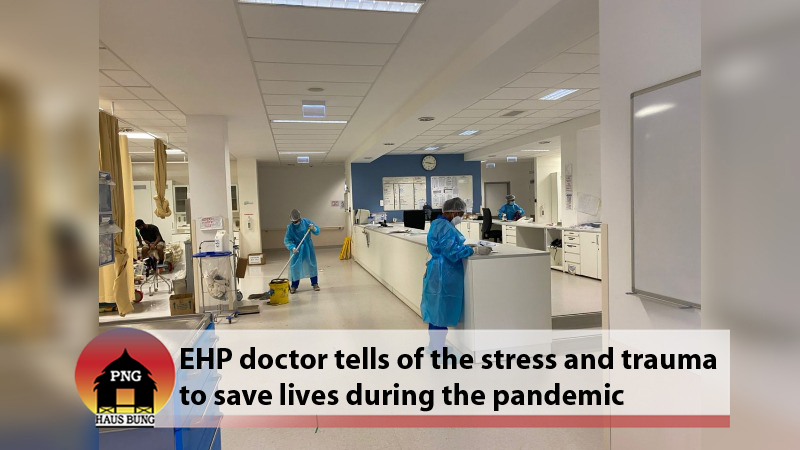 "I PASSED THE VIRUS TO MY SON" - Doctor’s worst nightmare
They leave their families at home, go to work at the hospital, the epic centre of the current COVID-19 surge in the Eastern Highlands Province.
Doctors and Nurses of the Goroka Hospital risk their lives every day since the surge started in early September, hoping they don’t take the virus back to their families.
Some have managed to come this far without contracting the virus, but it was unfortunate for one doctor who tested positive to COVID-19 and passed it on to his mother and his 7-year-old son at home.
Dr David Nangen, a surgeon at the hospital and his wife who also works at the surgical ward both contracted the virus unknowingly, took it home and infected the two very people they have been trying to protect from the virus.
An emotional Dr Nangen said it was a very stressful and difficult time for him and his wife when they found out that their 7-year-old son also tested positive to COVD-19.
He said he watched COVID-19 patients collapsing and dying in front of him back at the hospital and he took it hard on himself knowing that he passed the virus to his son.
“As parents, we try to protect our children from all harm and for me trying to fully grasp the fact that I took the virus home and passed it to my son was painfully hard for me to bear.”
“I was stressed and traumatised for days because I was already witnessing the full extent of what COVID-19 was doing to people and I didn’t think that someone I truly cared and loved would contract the virus., said Dr Nangen.
He said he has been working in the hospital for 16 years and he has never experienced such stress and trauma until recently.
The whole family are currently isolating at home, recovering slowly from the virus.
Dr Nangen said he is grateful that his family have been brought up in the church so when the worst happened to them, they prayed together, and they are all recovering well from home.
Published on October 11, 2021
 PUBLIC TRANSPORT IN AND OUT OF GOROKA TO STOP BY WEDNESDAY - EHP LOCKDOWN MEASURES
The Eastern Highlands Province will be going into lockdown as of tomorrow the 11th of October to the 26th of October.
Eastern Highlands Governor Peter Numu and the Provincial COVID-19 Controller John Gimiseve made the announcement over the weekend following the COVID-19 surge in the province that has spread to all eight districts in the province killing many people.
Mr Gimiseve said though the lockdown will start on Monday, it will be effective as of Wednesday with all eight districts restricted from coming into Goroka town except for essential services.
"By Wednesday, there will be a total lockdown of intra provincial movement."
"The eight districts will be kept at bay."
“There will be roadblocks set up by police between districts so for the next two weeks, movements in and out of districts will not happen.”
“All public transport will stop by Wednesday, no travelling back and forth from the upper Highlands down to the Coast and vice versa.”
“For those that live within Goroka town should take note that few of the essential shops will open from 8am-2pm only and you can only access those shops between that time, followed by curfew after 2pm.”
“We have asked shop owners within the town area to scale down their staff to below 20 as per the national directives from the Controller.”
As for schools, the Grade Eight, Ten and Twelve students are the only students that will be allowed to attend classes as they have exams coming up while the rest of the students remain at home.
“That also creates more space in the schools and also we cannot stop these lot of students from going to school as they have exams coming up.”
Mr Gimiseve said they will be issuing exemption passes for essential services only.
"Essential services include medical evacuation for vehicles that are moving sick people around, shop owners back in the districts that need to restock their store goods and big cargo trucks that need to pass through Goroka."
He said shop owners in the province should start applying to the Provincial Police Commander to obtain their exemption passes before Wednesday.
Cargo moving vehicles will also be issued exemption passes and their drivers will be tested at the checkpoints before they pass through Goroka.
“The drivers of the cargo vehicles are no different from the public, they will be tested at the two check points.”
“One check point will be on the Eastern End which will be down at Kassam Yonki and the other checkpoint will be at the Western End which will be at Chimbu Eastern Highlands boarder,” said Gimiseve.
As for the airlines, they will be allowed to operate with the provincial COVID-19 surveillance team to step up on testing at the airport upon arrivals.
Mr Gimiseve said they will stop flights from coming in if they do detect the virus from the passengers.
He said all the police officers in the province have been tasked to carry out surveillance and security during this lockdown therefore, minor crimes will not be entertained except for major crimes.
“All police have been deployed to do this, therefore our Goroka police station will only deal with serious matters such as, rape, armed robbery and murder, all the other cases will have to wait until situation is back to normal.”
The Police officers will all be tested for COVID-19 and only those with negative results will be allowed to be part of the lockdown surveillance team.
Mr Gimiseve said as much as possible, they don’t want to restrict people from moving around however, it is unfortunate that the virus is moving with people from one place to another.
“We want people to move around freely but unfortunately when the move, they move with the virus.”
“The virus is not something we can physically hold and deal with it separately from the human beings.”
“In order to kill the virus, we have to deal with carriers.”
He said a postmortem will be done after the two weeks lockdown to assess the situation and if there is no improvement then drastic actions will be taken.
“If it goes from bad to worse then we will just say that Eastern Highlands will be closed to the rest of the world for whatever period that would be deemed necessary,” said Mr Gimiseve.
Published on October 10, 2021