

POSTS BY AUTHOR

PNG Haus Bung
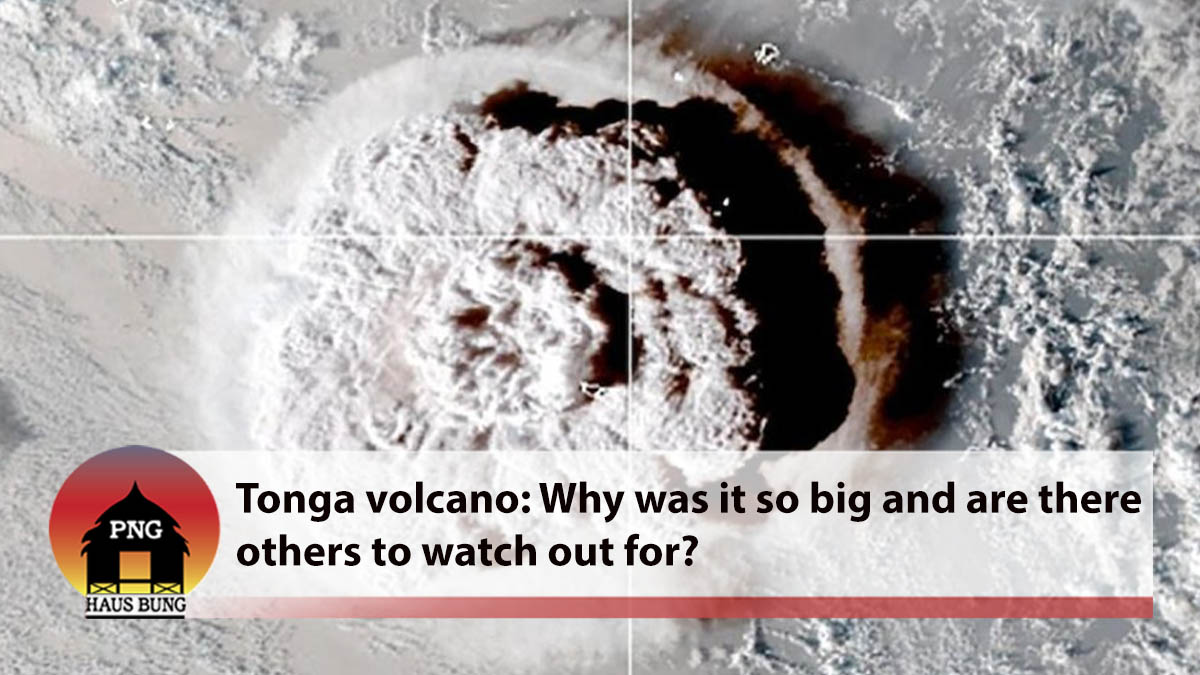 TONGA VOLCANO: WHY WAS IT SO BIG, AND ARE THERE OTHERS WE NEED TO WATCH OUT FOR?
When the Hunga Tonga Hunga Ha'apai volcano erupted in Tonga on Saturday, it sent a huge plume 30 kilometres into the sky and a literal shockwave around the world.
Every week there are around 20 volcanoes "showing some signs of unrest" across the globe, but most are fairly mild, says Scott Bryan, a volcano researcher at the Queensland University of Technology.
So what made this volcano so explosive, was the eruption predicted, will it erupt again soon, and are there other volcanoes we should be watching out for?
Why was it so explosive?
[caption id="attachment_18451" align="aligncenter" width="829"] A graphic showing volcanic activity and Earth's tectonic plates.(Encyclopaedia Britannica/UIG via Getty Images)[/caption]
The Hunga Tonga-Hunga Ha'apai volcano is what is known as a subduction volcano.
Subduction zone volcanoes occur along tectonic plate boundaries where one plate is being forced down under another.
Subduction volcanoes tend to have dual personalities, according to Professor Bryan.
On the one hand, they have slow, passive eruptions that build the classic conical shape of volcanoes like Mt Fuji, and on the other they're violently explosive, as we've seen in Tonga.
There are two factors that can lead to a highly explosive eruption, and although it's still too early to say definitively, it appears both factors may have been at play on Saturday.
The first is a high concentration of pressurised water vapour and gases in the magma.
When that magma hits the surface from deep underground, there's a sudden release of pressure "like opening a champagne bottle", which causes the gases to explosively expand, blasting apart the magma or lava in the process.
In the case of Hunga Tonga-Hunga Ha'apai, researchers had previously looked at the chemical composition of the volcano's lava sediment from an eruption in 2009.
They found the lava had ingredients for a powerful explosion, according to Heather Handley, a volcanologist from Monash University who was involved with that research.
"We could see from the chemistry of the rocks that the magma of that eruption was moving to the surface quickly and keeping hold of its gas as well," Dr Handley said.
The second factor that made the Tongan volcano so explosive was that it was a sub-surface volcano — its lava vent was under the ocean.
When magma hits water, it causes an explosive interaction between the two as the water rapidly flashes to steam, Professor Bryan said.
"It's the external addition of the water and the heat of the magma coming into contact with it," he said.
The volcano's vent was above water before disappearing below sea level just a few days (or hours) prior to Saturday's catastrophic eruption, according to Dr Handley.
[caption id="attachment_18452" align="aligncenter" width="834"] The volcano is seen smoking on January 7. Sometime after this an eruption or collapse caused it to go sub-surface.(Planet Labs PBC via AP)[/caption]
"The satellite images, if you compare from the 6th of January to two hours before the eruption, somewhere in that time frame the middle cone had gone," she said.
A smaller eruption may have blown apart the cone, allowing the incursion of seawater into the vent, which then catalysed the larger eruption.
But Professor Bryan suspects an underwater slip or collapse may have magnified the eruption and caused the tsunami that went with it.
"You need to displace ocean water to make tsunamis," he said.
"It's more than just the eruption. Something else has happened underwater that's triggered this explosion."
Was the eruption predicted?
The Hunga Tonga-Hunga Ha'apai volcano was on a roughly 1,000-year eruption cycle, according to high-temperature geochemist Oliver Nebel of Monash University.
But that doesn't mean we could have pinpointed with any real accuracy when it was going to erupt.
"We know … it's due [to erupt], but that could mean yesterday or it could be in 100 years," Dr Nebel said.
But there were some signs Hunga Tonga-Hunga Ha'apai was becoming more active, he said.
[caption id="attachment_18453" align="aligncenter" width="839"] The eruption on Saturday was made larger after the volcano became sub-surface.(AFP: Tonga Geological Services/Eyepress)[/caption]
Dr Handley said the volcano entered a phase of increased activity sometime around December 19-20.
"In the past few weeks, you've been seeing what we call phreatomagmatic eruptions, where water and magma are coming into contact," she said.
"You get these dark feathered plumes that come out."
According to the database of the Global Volcanism Program, gas steam and ash plumes had risen at least 12.2 kilometres into the air by late December, but activity had "significantly decreased" by early January.
The difficulty in evacuating people when volcanoes enter more active phases is that often they may settle down again without a catastrophic eruption, Dr Nebel said.
Evacuating people any time a volcano showed signs of activity would not only be costly, but it would lead to an erosion of public trust in scientists, he added.
Will it erupt again soon?
When a volcano like this erupts, it often happens as a series of eruptions, rather than a one-off.
Records from the Global Volcanism Program show that the last period of activity at Hunga Tonga-Hunga Ha'apai, which began in December 2014, lasted just over a year.
During that period a new island was formed, about 120 metres high and about 2 kilometres long.
Dr Nebel said he suspected there would likely be more eruptions in the near future.
"It's really hard, slash impossible, to predict whether it will be the same severity."
[caption id="attachment_18454" align="aligncenter" width="873"] A combination of satellite images taken by Himawari-8, a Japanese weather satellite operated by Japan Meteorological Agency shows the eruption.(NICT via AP)[/caption]
A huge eruption like this one may mean that any following eruptions will be less intense; however, again, there are no guarantees.
The problem is that the magma chamber can be tens of kilometres deep, and there's no way of knowing how much more magma is still in the chamber.
"The only thing we can say is that it has erupted now, so the likelihood of there being much more underneath is low, but we have seen [multiple large eruptions] before in the past," Dr Nebel said.
Similarly, Dr Handley said it was "impossible to tell" at this point whether we had seen the biggest eruption, or if there were more to come.
Professor Bryan said if there was an underwater landslide that precipitated the eruption, that may actually be good news in terms of future eruptions.
"Hopefully if there was a landslide or whatever happened on Saturday, it's stabilised the slopes to some extent," he said.
"[In that case] we may have some explosions or tall columns, but we're not going to get the tsunamis."
Though the fallout and potential death toll is still unknown, Professor Bryan said the earlier eruptions at least gave the people of Tonga some forewarning of what may have been coming.
He also said the fact it happened in daylight was a small positive.
"By the sounds of it, most people saw the early signs. Obviously there was a sonic boom and they'd seen the columns from the weeks before.
"If this happened like three hours later in the middle of the night [when] people are asleep, it could have been a lot worse."
Are there other volcanoes like this to watch out for?
Volcanoes like Hunga Tonga-Hunga Ha'apai are part of the Pacific Ring of Fire — a roughly 40,000km line around the Pacific Ocean tracing the edge of tectonic plates, where a large share of the world's volcanoes are found.
However, these have what is referred to as an "independent magmatic plumbing system", Dr Nebel said.
What that means is that their magma chambers and any conduits and vents are in no way connected to other volcanoes, and the eruption of one doesn't precipitate the eruption of any others.
Across the world there are more than 1,300 active volcanoes, but active doesn't mean erupting now, according to Dr Handley.
"To be active, we say they erupted in the last 10,000 years," she said.
In any week there are around 20 volcanoes showing signs of activity, according to Professor Bryan.
The Global Volcanism Program listed 46 volcanoes as "in continuing eruptions status" as of December 9, 2021.
A number of these are in Australia's Pacific neighbours, including Papua New Guinea, Solomon Islands and Tonga.
As we've seen, predicting which volcanoes may be an imminent threat to life can prove extremely difficult, but volcano experts say more monitoring and tsunami early warning systems can help.
"All of these volcanoes need monitoring, because our ability to predict these eruptions sometimes is in the order of hours," Dr Nebel said.
SOURCE: ABC NEWS
Published on January 18, 2022
 DEPARTMENT OF ICT SIGNS MOU WITH ROMANIAN CLUJ IT CLUSTER TO DELIVER DIGITAL ECONOMY
On January 9th, the Department of Information and Communication Technology signed a Memorandum of Understanding (MOU) with the Cluj IT Cluster of Romania, which sets the stepping stones for cooperation in the area of building the digital economy through establishing a proven cluster model in PNG.
The Memorandum of Understanding signing took place in the presence of Mr. Steven Matainaho, Secretary of the Department of Information and Communication Technology and Cluj IT’s Vice President and coordinator of internationalization activities, Daniel Homorodean, and the official delegation of Papua New Guinea.
The event marks an important step for the collaboration between Papua New Guinea and Romania in the digital transformation and digital economy perspective, Cluj IT being engaged to provide immediate support in strategic areas, such as the development of the Papua New Guinea ICT Incubator, development of the Papua New Guinea clusterization policy and of the PNG ICT Cluster the development of the digital transformation strategies, public policies, standards and good practices and developing of the direct business collaboration between companies from Romania and from Papua New Guinea.
The digital government project under the PNG Cabinet approved Digital Transformation Policy (NEC Decision 252/2020) will position the Government as a client of many ICT solutions providers, preferably local nationals.
The Department of ICT intends to use this major government investment to create an ecosystem in which local ICT SMEs with international partners combine to innovate and provide solutions.
In any State partnership with international providers, it is the duty of the government to provide international exposure for local businesses and grounds for knowledge acquisition.
With this foresight under the leadership of Secretary Matainaho, the MOU intends to pave a direction for the PNG ICT industry in the next 5 and 10 years.
Papua New Guinea aims to become a leading provider of ICT solutions in the South Pacific and through the MOU with Cluj IT Cluster, there is a foreseen acceleration in the start-up of PNG-based firms in partnership with mature clusters such as Cluj in Romania.
Papua New Guinea kindly thanks the Romanian Pavilion Expo 2020 Dubai for hosting this momentous event.
Published on January 18, 2022
 COVID-19 BOOSTER VACCINE APPROVED FOR BETTER PROTECTION
The Controller of the National COVID-19 Pandemic Response, Police Commissioner David Manning, has advised that booster shots of the COVID-19 vaccine have now been approved for use in Papua New Guinea.
Mr. Manning said that the National Control Centre has been provided advice from the Medical and Scientific Advisory Committee (MESAC) that the additional vaccine coverage is now recommended.
“MESAC have advised that there is now overwhelming evidence that a COVID-19 booster shot is prudent even for people who are fully vaccinated as an additional layer of protection.
“The booster shot is be important for people who have compromised immune systems or other underlying health conditions, and the elderly.
“But also more generally, people who had their primary vaccination more than six months ago should receive a booster dose to enhance effectiveness.
“The MESAC recommendation is inline with prevailing advice from medical specialists in partner countries and the World Health Organization.”
Professor Sir Isi Kevau, the MESAC Deputy Chairman, at the University of Papua New New Guinea School of Medicine and Health Sciences, provided the formal advice to the National Control Centre.
Commissioner Manning said the MESAC advice is that the booster dose should ideally be of the same vaccine as the person originally received, but this can be changed for those who have received Astrazeneca or Sinopharm.
“This means a person who has been fully vaccinated with Astrazeneca or Sinopharm vaccine should receive a booster shot of Astrazeneca or Johnson & Johnson. While those who have had a Johnson & Johnson single dose vaccine should receive a Johnson & Johnson booster shot. If in doubt, simply ask a medical professional.”
The Controller said that there is no change to the availability of COVID-19 vaccines, and receiving the vaccine remains entirely voluntary.
“People will continue to exercise freedom of choice in terms of if they wish to receive the COVID-19 vaccine and to which type of vaccine they wish to receive.
This is the principle that the Prime Minister has declared from the start and there is no change."
"It is simply advisable that the best way to survive COVID-19 is to be vaccinated."
"As has been proven in countries around the world, receiving the vaccine is the best way to prevent serious infection and death from COVID-19 and this remains a matter of personal choice."
"Everyone who is entitled to receive a booster vaccine is able to receive this from any medical facility where vaccines are being made available."
Published on January 17, 2022
 USP LAUNCHES ONE-OF-A-KIND SEMESTER ZERO
The University of the South Pacific (USP) today launched Semester Zero, a one-of-a-kind initiative and a first-of-its-kind programme, for its provisional and potential first-year students to learn more about the University and get a "feel" of university life.
The initiative is the outcome of a collaboration between the Commonwealth of Learning Sponsorship (COL) and the USP's Centre for Flexible Learning (CFL), concretising the University's vision of an online orientation programme for its students. Commencing January 24, future USP students will have the opportunity to experience what tertiary education is like for the next six weeks.
In her welcome address, Director CFL, Dr Rajni Chand said in the past, Orientation programmes at USP used to be a flurry of activity on all of the University's campuses.
This year, according to Dr Chand, things may be a little different because students may not travel to the Laucala Campus for their studies.
"However, these obstacles should not prevent them from receiving the much-needed orientation, nurturing, and support. It should not prevent them from learning about the University and its learning and teaching environment, as well as its various campuses, services, and facilities, which is why Semester Zero was created," she said.
She explained that the COL-sponsored Moodle page would allow students to experience tertiary learning from the safety and comfort of their own homes while also providing remedial, confidence building, and familiarity with university study—an orientation experience that they may not get this year if the pandemic continues.
USP Vice-Chancellor and President, Professor Pal Ahluwalia stated it was an honour to see Semester Zero come to fruition enabling students to experience the unique university life.
"This programme is significantly different. We have created an online learning platform that will not only provide all of the necessary information about USP, but will also provide additional introductory literacy, numeracy, and digital skills through games, quizzes, notes, and study guides," he added.
"We must think creatively in order to notensure that our people are connected but also to provide meaningful transitions to all of our prospective students, regardless of their location. The past year has been turbulent, owing in large part to the COVID-19 pandemic and the disruption that has resulted from it."
He thanked the entire team for their hard work and dedication.
Vice-President of COL, Dr Venkataraman Balaji, was proud of USP’s vision in ensuring that no student was left out especially in a stressful situation.
"We have a pandemic that is raging all over the place; we have the cyclone season, which is bad enough, and then we had this most unexpected event, the volcanic eruption in Tonga. As a result, we want to make certain that your voice is heard. We want to make certain that your priorities are understood and addressed. We want to make sure that your needs are met as soon as possible," he emphasised.
Dr Balaji went on to say they were delighted to collaborate with USP and looked forward to working more closely in the future.
Commonwealth of Learning Adviser: Technology Enabled Learning, Dr Nantha Kumar Subramaniam said it was an excellent and innovative approach in ensuring the learners received uninterrupted methods during this pandemic.
The Acting Deputy Vice-Chancellor Education, Professor Jito Vanualailai demonstrated the Semester Zero page.
"It is a handy tool for potential students to learn ahead of time. It contains all of the necessary components and there are no longer any constraints for students,” Professor Vanualailai added.
Students from Fiji who have been offered provisional admission are invited to go to the Moodle page URL provided in their provisional offer letter, enrol in the free programme, and enjoy the next six weeks as they wait for USP to formally begin. Students who have not yet submitted their provisional application may do so on the following link www.usp.ac.fj/enrolme . Regional students with a confirmed offer letter are eligible to enrol in the programme.
Published on January 17, 2022
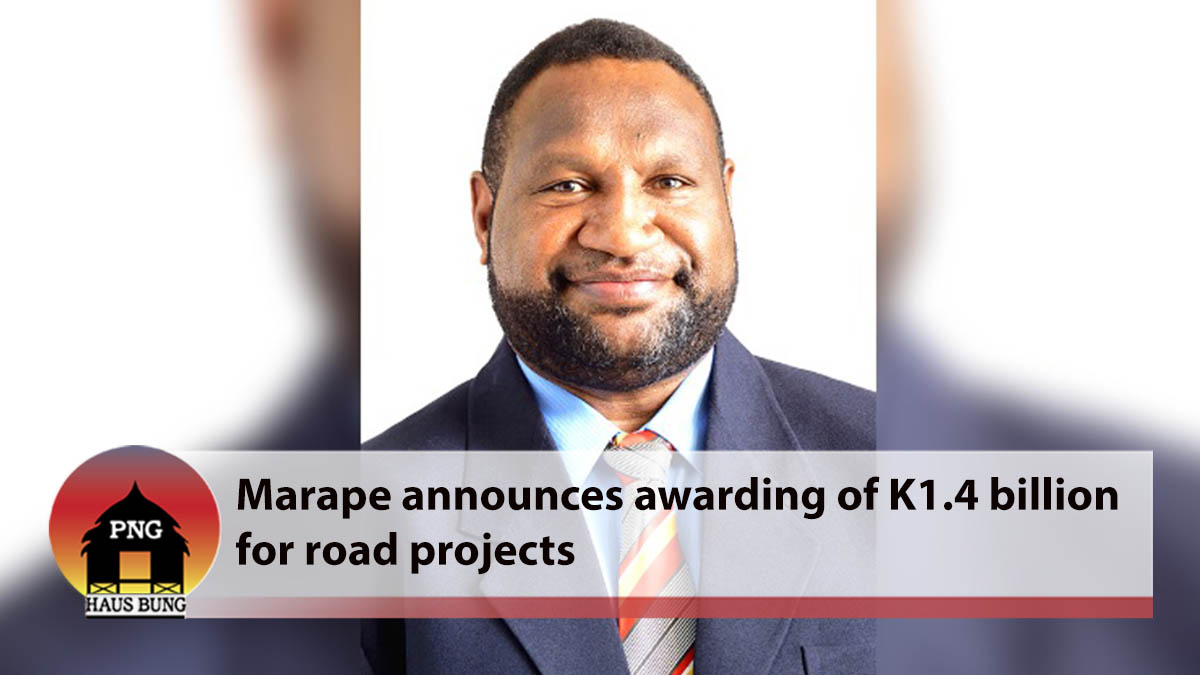 PM MARAPE ANNOUNCES AWARDING OF K1.4 BILLION OF ROAD CONTRACTS THROUGHOUT PNG
Prime Minister Hon. James Marape has announced the awarding of more than K1.4 billion of new road contracts throughout Papua New Guinea.
He announced the Cabinet decision before a massive crowd of thousands of people in rural Margarima, Hela, on Friday (January 14 2022).
The K1.4 billion worth of road contracts add to those already in place under the Marape Government’s signature ‘Connect PNG Programme’ for which about K1 billion has been expended over the last two years on roads throughout the country.
The Prime Minister announced the awarding of contracts of:
• K159 million for the Ramu-Madang stretch of the Ramu Highway in Madang;
• K147.5 million for the first stretch of the Wewak-Vanimo Highway up to Aitape;
• K115.9 million for the Momote Airport-West Coast Road in Manus;
• K164 million for upgrade of Imulima Bridge-Moreguina stretch of Magi Highway in Central, to eventually link up with Milne Bay;
• K70 million for Bautauma-Imulima Bridge section of Magi Highway in Central;
• K138.5 million for New Britain Highway from Kimbe in West New Britain to Kokopo in East New Britain;
• K400 million for Yalu Bridge-Nadzab Four-Lane Highway in Markham Valley of Morobe;
• K50 million for sealing of Kiunga-Tabubil Highway in Western, which will ultimately lead on to remote Telefomin in West Sepik;
• K15 million for sealing of Daru Town roads;
• K66 million for Bulolo Highway resealing; and
• K80 million for sealing of Halimbu-Koroba Road in Hela;
These add up to K1.4 billion.
“Over the last two years, we have spent almost K1 billion on roads all over Papua New Guinea,” PM Marape said.
“That’s why roads are already going into remote places like Maramuni in Enga, Karamui in Chimbu, Simbai in Madang and Finschhafen in Morobe.”
Published on January 17, 2022
 WARD MEMBER ORGANISE SUCCESSFUL SPORTING EVENT
A local ward councillor in central province has stamped a momentous achievement albeit his first term through organising a successful festive volleyball sporting event that will end with a grand final berth at the end of this month.
The Mesime Ward 3 in the Koiari Local Level Government (LLG) in the Kairuku Hiri electorate will see the festive sporting event come to its conclusion after a two-month contest since December, 1st, 2021.
This was made possible by an aspiring young and vibrant leader who has manifested in sports as a material gadget that could trigger change in communities through sports.
This will be the third organised festive sporting event since 2018.
Allan, mixed parentage of Waima in Kairuku and Koiari in Hiri, had left his well-paid job with the Hugo Cannery in Port Moresby for the sake of the community he had lived in the last 40 years.
His community on the outskirts of Port Moresby along the Sogeri Road is known to crop some of the country’s dangerous criminals.
His beckoning came with a reason and tried his luck for the ward council election in 2018.
Allan’s enlightenment was to focus on his ‘back to school’ sports program.
‘’I made it a priority to engage students in sports in their long holidays in the festive season.
‘’We all know that lawlessness is a major problem experienced in every single community throughout the country. Thus, has become a habit and epidemic that has gone out of control.‘’
He said it is a responsibility for every leader at the community level to address the issue.
‘’Therefore the two months back to school sports program is an initiative taken when I entered office in 2018,’ he said.
He said six teams contested and since the start of the volleyball tournament and four teams comprised of men and women teams have made it through the grand finale.
Nata Minas will take on Saika Bullets in the men’s division while Kuma Stars will spike their best against the aggressive Nata Minas side in the women’s division.
He thanked various business houses, office of the Governor for Central and the office of the MP for Kairuku Hiri for their support towards the tournament.
Published on January 17, 2022
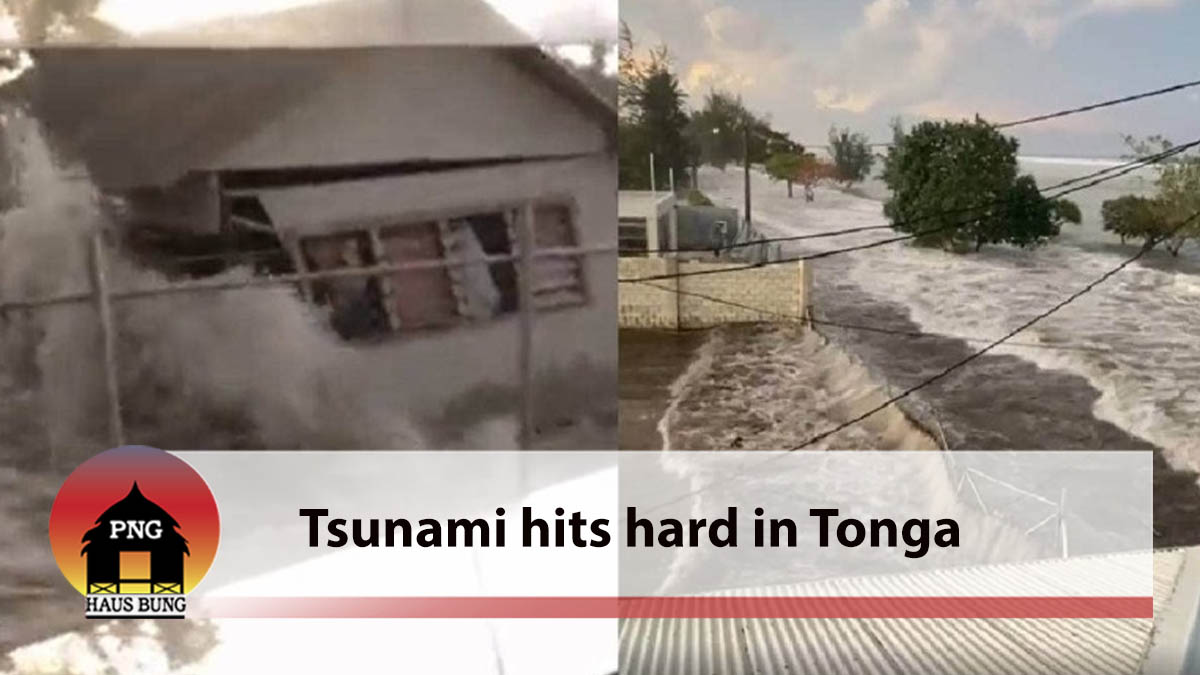 TSUNAMI WAVES CRASH THROUGH HOMES IN TONGA AFTER UNDERWATER VOLCANO ERUPTION
A tsunami has hit Tonga, after a massive eruption from an underwater volcano near the Pacific Island nation on Saturday.
Waves surged through coastal Tongan areas, crashing into people’s homes after Hunga-Tonga-Hunga-Ha'apai erupted around 5.30pm on Saturday, NZ time.
The Pacific Tsunami Warning Center in Hawaii, US, confirmed the eruption generated a tsunami late on Saturday night. It followed an earlier eruption, on Friday, that sent ash, steam and gas 20 kilometres into the air.
Stories of horror and despair quickly emerged in the aftermath of the tsunami. Locals described waves hitting their homes as they ate dinner, and one man had to carry his grandmother as they fled to the roof of their house.
Mere Taufa was inside her house with her family, getting ready for dinner, when they heard and felt the eruption.
“It was massive, the ground shook, our house was shaking. It came in waves, my younger brother thought bombs were exploding nearby,” Taufa said.
"My first instinct was to take cover under the table, I grabbed my little sister, and screamed at my parents and others in the house to do the same."
She said next thing they knew, water had filled their home.
“We just knew straight away it was a tsunami. Just water gushing into our home.”
She saw the walls of one of her neighbours’ homes collapsed, from her own window.
“You could just hear screams everywhere, people screaming for safety, for everyone to get to higher ground.”
Tevita Sailosi carried his elderly grandmother to the roof of their Nuku’alofa home after the tsunami hit.
“We're still in shock to be honest, first we heard the explosion, and then water was in our house,” Sailosi said on Saturday night.
His family was safe, but worried about what the night would bring.
“Hopefully we're out of this now, and there aren't any more waves. Right now we're just staying put, we've got our phones and radio on, for any updates.
“We've heard screaming, people have helped where they could. We've also heard some singing too, so that's lifted our spirits a bit. We just hope everyone else is safe out there.”
A local who did not want to be named told Stuff the New Zealand High Commission complex was “filled with people, and they're running out of food to feed them”.
They said "Sopu, Popua, Fangaloto, Patangata were underwater at last light" and it was "scary dark everywhere".
“One boy who just arrived soaking wet said he ran out of his friends’ home not knowing what happened to his family. He's not sure if they made it out of their home as they don't have a car to leave in.”
The volcano is located about 30 kilometres south-east of Fonuafo'ou island in Tonga.
It was erupting intermittently in late December.
[caption id="attachment_18405" align="aligncenter" width="850"] This satellite image taken by Himawari-8, a Japanese weather satellite, shows the eruption as it appeared from space.[/caption]
New Zealanders warned to move off beaches
A national advisory was issued by New Zealand’s National Emergency Management Agency shortly after 8.15pm on Saturday, warning it expected coastal areas on the north and east coast of the North Island to experience “strong and unusual currents” and “unpredictable surges at the shore”.
NEMA said there was a danger to swimmers, surfers, people fishing, small boats and anyone in or near the water close to shore.
People in or near the sea should move out of the water, off beaches and shore areas and away from harbours, rivers and estuaries until at least 4am on Sunday, and people were warned not to go to the coast to watch “unusual” wave activity.
Coastal inundation (flooding of areas near the shore) was not expected, and there was no need to evacuate other areas unless directly advised by local civil defence authorities, the advisory stated.
The currents and surges would continue for several hours and the threat "must be regarded as real" until the advisory was cancelled, NEMA said.
The NZDF said it was monitoring the situation on Saturday night, and was ready to assist if the Tongan Government requested help.
‘Raining' stones in Tonga
Jese Tuisinu, a reporter at Fiji One, posted a video on Twitter showing it was “dark” in parts of the island, and said people were “rushing to safety” following the eruption.
United States-based former safety and protection cluster co-ordinator for the Ministry of Internal Affairs Lavinia Taumoepeau-Latu was on the phone with her husband at the time, but lost the connection.
While they were speaking, it went dark and began raining small stones.
Her husband told her there were people trying to evacuate to higher ground, but as there was only one main road from the town messages on the radio were telling people from central and eastern areas to stay put to allow others to evacuate.
Eruption felt in other countries
People from as far away as neighbouring Fiji – northwest of Tonga – reported hearing or feeling the eruption on social media on Saturday night.
Dr Frank Ross, who lives in Suva, Fiji – over 800km away from Tonga - said there had been "constant, on-and-off booms" for over half an hour that were still ongoing at 7pm NZ time.
“The house has been shaking, I've figured out that it must have been from this eruption.
“I went outside, and it sounded like this constant boom, boom, boom in the distance, but there wasn't any thunder ... it must have been massive,” he said.
“It was even shaking a few minutes ago – it comes and goes, so it must be a series of eruptions. It's been going on for half an hour or 45 minutes,” he said on Saturday night.
Ross said there were no signs of any disruption to the sea near his home, which he said was about 100m from the sea.
The United States issued a tsunami advisory for American Samoa following the eruption, but cancelled it later on Saturday night.
Evacuations took place on Savai’i, Samoa on Saturday night, according to local media reports.
The Fijian Government also advised those living in low-lying coastal areas to move to higher ground in anticipation of strong currents and dangerous waves. Fiji opened evacuation centres on Saturday night due to the “unusual tidal waves”.
New Zealand reaction
The Ministry of Foreign Affairs and Trade (MFAT) said there were 18 New Zealanders registered on SafeTravel as being in Tonga.
MFAT had “no information” on Saturday night on whether any New Zealanders had been affected.
All New Zealanders in Tonga are advised to register their details on www.safetravel.govt.nz.
If you require consular assistance please contact the New Zealand High Commission in Nuku’alofa on +676 23122 or for consular emergencies +64 99 20 20 20.
Meanwhile, Metservice reported a “pressure surge” from the latest eruption had been observed in weather stations across New Zealand.
People on social media were also reporting hearing “sonic booms” across New Zealand.
Tauranga couple Kris and Tim, who didn't want their last name used, believed they felt the eruption while sitting in their living room.
“We were watching TV and the wind is blowing, birds are tweeting, so over top of all that we heard a very loud rumble, like a boom, and we both looked at each other and said 'what the heck was that?'.
"It was very intense, it was a low rumble very far away," they told Stuff.
“It was like Jurassic Park. As if the T. rex was coming in the distance and the water on the dash is vibrating. That's what it was like.”
SOURCE: STUFF NEWS
Published on January 16, 2022
 PRINCE HARRY SEEKS JUDICIAL REVIEW AFTER HOME OFFICE STOPS HIM FROM PAYING FOR POLICE PROTECTION IN UK
Prince Harry has filed a claim for a judicial review over a Home Office decision to not to allow him to privately pay for police protection for himself and his family during a visit to the UK.
A legal representative for Harry said he wants to bring his son Archie and seven-month-old baby daughter Lilibet to visit from the US, but fears they will be "unable to return to his home" because it is too dangerous.
The duke wants to fund the security himself, rather than ask taxpayers to foot the bill after he stepped down as a senior member of the Royal Family.
Harry is now arguing his private protection team in the US does not have access to UK intelligence information which is needed to keep his wife and children family safe.
The legal representative for the duke said in a statement: "The UK will always be Prince Harry's home and a country he wants his wife and children to be safe in.
[caption id="attachment_18399" align="alignnone" width="846"] Prince Harry and Meghan Markle shared an adorable family photo featuring their two children Archie and Lilibet for their Christmas card. Pic: Alexi Lubomirski[/caption]
"With the lack of police protection, comes too great a personal risk."
The representative added: "The Duke and Duchess of Sussex personally fund a private security team for their family, yet that security cannot replicate the necessary police protection needed whilst in the UK.
"In the absence of such protection, Prince Harry and his family are unable to return to his home."
Harry briefly returned from the US last July for the unveiling of a statue of his late mother Princess Diana.
The day before, he met seriously ill children and young people at a WellChild garden party and afternoon tea in Kew Gardens, west London.
[caption id="attachment_18398" align="aligncenter" width="831"] The Duke of Sussex now lives in California with Meghan and their two children[/caption]
However, it is understood the duke's car was chased by photographers as he left.
Harry has shared his concerns in the past about his family's safety after Diana died in a car crash after she was chased by the paparazzi in Paris in 1997.
The legal representative added: "Prince Harry inherited a security risk at birth, for life. He remains sixth in line to the throne, served two tours of combat duty in Afghanistan, and in recent years his family has been subjected to well-documented neo-Nazi and extremist threats.
"While his role within the Institution has changed, his profile as a member of the Royal Family has not. Nor has the threat to him and his family."
SOURCE: SKY NEWS
Published on January 16, 2022
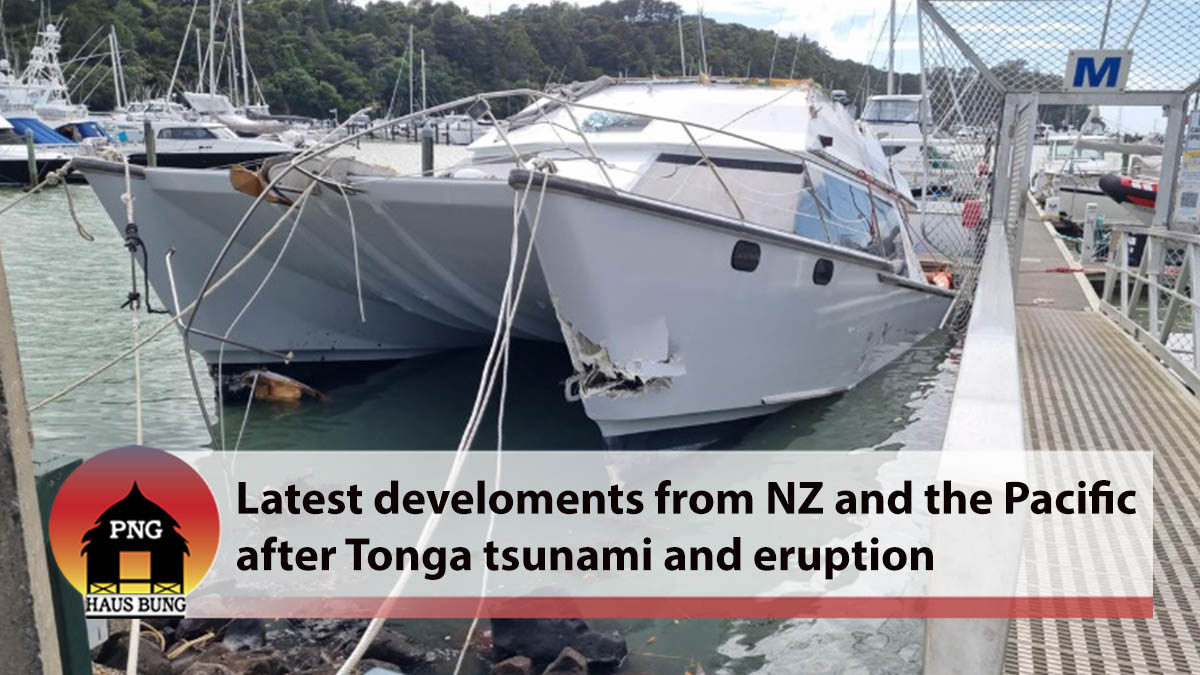 CYCLONE CODY: LATEST DEVELOPMENTS FROM NEW ZEALAND AND THE PACIFIC AFTER TONGA TSUNAMI AND ERUPTION
Prime Minister Jacinda Ardern will hold a media conference this afternoon to address New Zealand's response to the crisis in Tonga.
In a post on her Facebook page, Ardern said images of the volcanic eruption were "hugely concerning".
She said communication as a result of the eruption had been difficult but the New Zealand Defence Force and the Ministry of Foreign Affairs were working to establish what what needed and how to help.
More information would be provided during the media conference at 3pm, she said.
The Ministry of Foreign Affairs and Trade said there were no official reports of deaths or injuries in Tonga, however communication remained limited.
New Zealand's High Commission in Nuku'alofa is in contact with local authorities and said damage assessments were underway.
An NZDF P3 Orion is on standby to fly over the area once atmospheric conditions allow.
There are currently 30 New Zealanders registered as being in Tonga.
Alerts in place for New Zealand
The west coast of the South Island has been included in a warning about dangerous sea conditions as a result of the volcanic eruption in Tonga.
The National Emergency Management Agency this morning said that coastal areas on the north and east coast of the North Island are expected to experience strong and unusual currents and unpredictable surges at the shore.
It said the conditions were dangerous for swimmers, surfers, people fishing, small boats and anyone in or near the water close to the shore.
The agency later also added the west coast of the South Island and the Chatham Islands to the advisory area.
It comes after a tsunami hit Tonga when underwater volcano Hunga-Tonga-Hunga-Ha'apai erupted for eight minutes, throwing clouds of ash into the sky, yesterday afternoon.
Waves flooded the capital Nuku'alofa, where video footage has shown water engulfing buildings.
The eruptions have been heard as booms or 'thumps' across the Pacific, in Fiji, Niue, Vanuatu, and in New Zealand.
RNZ listeners from Northland, to Wānaka in Central Otago have reported hearing what sounded like gunshots, loud bangs, or sonic booms.
Tsunami waves reported around the world
Meanwhile, the United States and Japan are warning people on their Pacific coastlines to stay away from the shore because of tsunami waves from the Tongan eruption.
Japan has warned of waves as high as three metres, and waves of 1.2 metres hit the south of the country.
The US warned of strong currents and waves, and coastal flooding.
The National Weather Service for Alaska also confirmed they had heard the eruption.
SOURCE: RNZ NEWS
Published on January 16, 2022
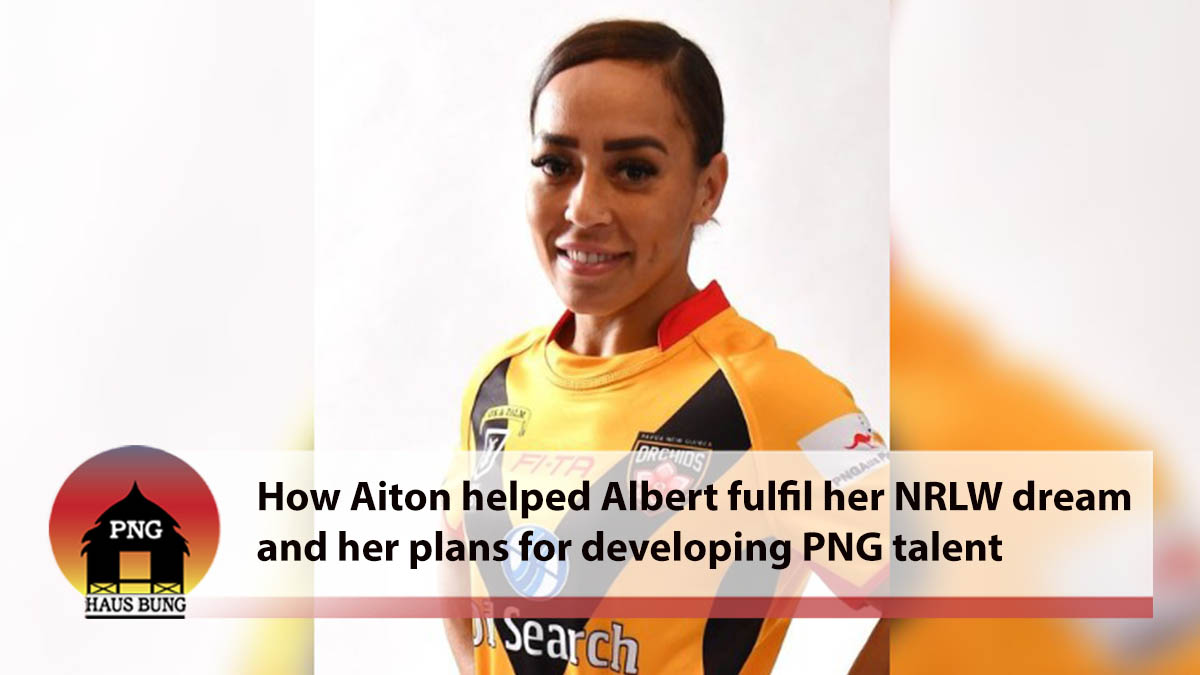 HOW AITON HELPED ALBERT FULFIL NRLW DREAM AND HER PLAN TO DEVELOP PNG TALENT
Eels hooker Therese Aiton isn’t just a trailblazer for Papua New Guinea players; she has established a pathway for more women from the Pacific nation to play in the NRLW.
Aiton, who is only the third Orchids international to earn an NRLW contract after Amelia Kuk and Elsie Albert, has created a scholarship program to help promising PNG players further their careers in Australia.
Albert, the Orchids captain and St George Illawarra prop, was the first beneficiary after Aiton organised for her to come to Brisbane in 2020 to play for Souths Logan Magpies.
The 32-year-old, whose brother Paul played more than 100 NRL matches for Penrith and Cronulla and represented the Kumuls in 16 Tests, accommodated Albert at her house in Brisbane until she earned an NRLW contract with the Dragons.
Albert again received help from Aiton, through the Hezekiah Sports Scholarship Foundation she founded, to return for the 2021 NRL Telstra Women’s Premiership, which kicks off on February 27 after being postponed due to COVID.
This time, Aiton will be lining up against Albert after being signed by Parramatta and the Orchids star is working to ensure that there are more PNG players in the NRLW in future years.
“Ideally, we wanted to bring more players here now but the whole visa process and the funding for that was huge,” Aiton said.
“A friend of mine runs a charity, His Harvest, so we just branched off that with the Hezekiah Sports Scholarship Foundation and through that, with whatever funding comes through, we can support more players to come over here.
“I’ve put up my house for accommodation for them. This year I have offered to take five or six girls in my own home and get them to training.
“We just need funding to support us with visas and flights to get them over here and whatever food they require when they are here, but we are happy to take them to training and accommodate them.
“We were able to get Elsie here for the first year with Souths Logan Magpies, which was great, and to support her to come over again this year with the scholarship I created, so hopefully we can bring more players over because there is just so much talent in PNG.”
Albert told of her struggle to return to Australia for the 2021 NRLW season and thanked the Hezekiah Sports Scholarship Foundation in a Facebook post after re-signing with the Dragons.
"The founder of the foundation is one of our PNG Orchids player, Therese Aiton," Albert said. "She created this foundation to help raise money to help our PNG girls to get the opportunity to play in Australia and achieve their dreams. A quick shout to His Harvest, as well, in helping to set up the foundation.
"I am fortunate enough to be one of the first one to be helped by this foundation. They helped sponsor for my ticket to come to Australia.
"At the beginning of the year, I pictured myself getting on a plane and flying to Australia and it took me seven months to finally settle everything and am now in Australia. Long story short the chances were 0%.
"Keeping my fingers crossed and keen to see what this foundation can achieve through helping our PNG girls in the near future."
Aiton said the inspiration for the scholarship program came after hearing about some of the obstacles female players still face in PNG to access training programs and gyms which would help with their development.
The Orchids, whose first Test was during the 2017 World Cup, enjoyed an historic win against England at Port Moresby in 2019 but Aiton said more support was needed at grassroots level if PNG was to compete with the Jillaroos and Kiwi Ferns.
“There is so much talent in PNG so we just want to get more girls into the competitions here and that’s what the scholarship is designed to do,” she said. “Even at A-grade and club level, the football in Australia is completely different to back in PNG.
“I really feel that the sooner we can get girls over here experiencing this level of football the easier it is going to be when they go back to PNG with the skills they have learned here, and they can support other girls to develop at home.”
Paul Aiton, who is on the coaching staff of the PNG Hunters, is working in Papua New Guinea to help organise for more women to be able to play in Australia.
Therese’s move to Parramatta may also open another pathway, with the Eels - through NRLW manager and former NSW women’s coach Andy Patmore - have expressed an interest in helping to develop players from PNG in their junior teams.
“They played a schoolgirl comp in PNG and there were quite a few young players who were switched on and just need that support to take their football career to the next level,” Aiton said.
“You just want to pluck out those players and give them the opportunity to do what Elsie has done, basically.
“The amazing thing for Elsie now is that not only has she been supported to work, she has got a two year visa, she has got an opportunity to study and it has just absolutely changed her life, so it would be nice to do that for a few more girls.”
SOURCE: NRL NEWS
Published on January 15, 2022
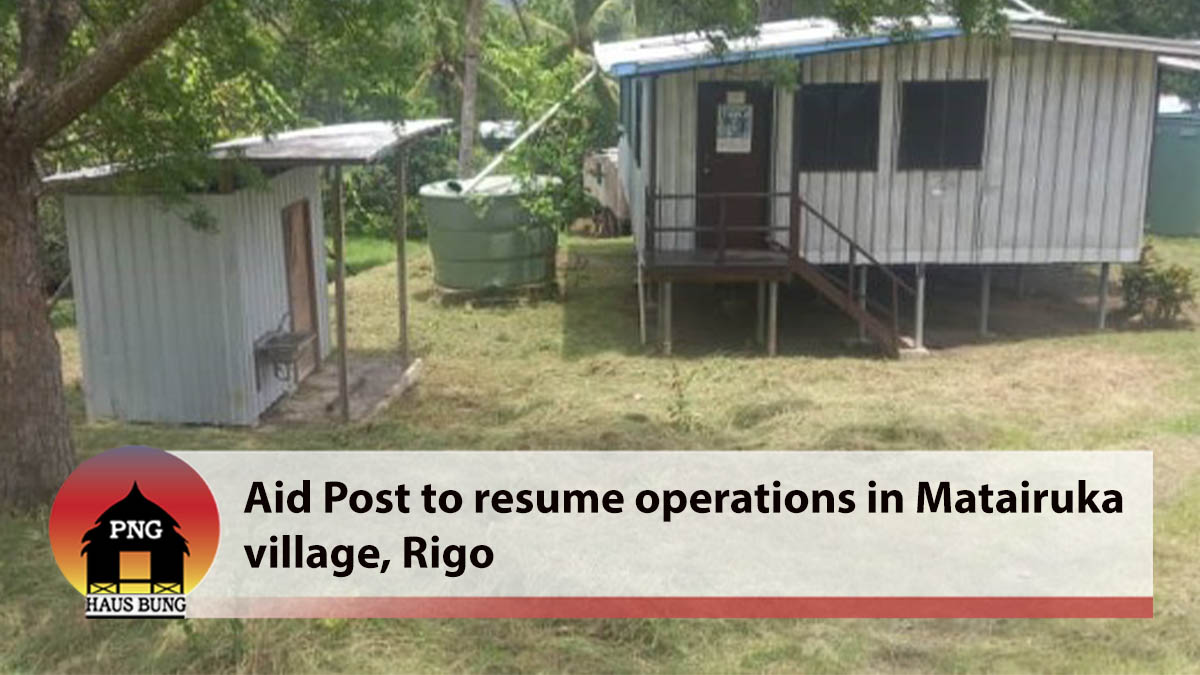 AID POST TO RESUME OPERATIONS AT MATAIRUKA VILLAGE IN RIGO, CENTRAL
Matairuka Village Councilor Mr Gelema Gaba is greatly relieved after his recent call to have a medical officer posted to his village was acted upon with The Salvation Army sending one medical officer to officially resume work at the aid post.
The villagers who have been accessing basic health services from Kwikila Town and the neighboring villages of Sivitatana and Boregaina with some even travelling to Port Moresby to seek health care will no longer have to travel far as the Aid Post which remained closed for 12 months will now resume operations as soon as preparations are complete.
Mr Gaba confirmed with this newsroom that the village community has already started work by cleaning around the Aid Post area and assisting where possible to have the facility ready for operations as soon as possible.
“I am now relieved and it’s like a burden has been taken off my shoulder because now my people will not have to travel far to access basic health care,” Mr Gaba said.
Mr Gaba said he has received advise from the new medical officer that the Aid Post will resume operations as soon as necessary medical equipment have been installed.
According to the medical officer, this will take about a week before the Aid Post can resume full operations and start treating patients again.
The councilor has made a call to villagers and those from nearby villages who will be accessing health services from the Aid Post to look after the facility and the people managing it so that the service can be ongoing without any hiccups.
“I would like to issue a friendly reminder to the people to make sure that the facilities and workers also are well looked after so that health services can continue to be made available for all to access,” he said.
Mr Gaba also expressed his gratitude to The Salvation Army for bringing health services to their village and acknowledged the great work they have done so far with regard to the providence of affordable basic health services in the village.
Published on January 15, 2022
 INDIA’S THIRD WAVE OF COVID INFECTIONS IS EXPECTED TO BLUNT GROWTH IN THE NEAR TERM
India is experiencing a third wave of Covid infections — while its overall impact is expected to be less disruptive than previous waves, some economists are predicting slower growth in the near term.
The economic impact of the new wave could be relatively less severe in the first three months of 2022, Citi economists Samiran Chakraborty and Baqar M Zaidi wrote in a Jan. 9 note.
But they pointed out that the momentum for India’s economic activity between October and December fell below expectations, even before the third wave hit.
That led the Citi economists to revise down their inflation-adjusted GDP estimates for India for fiscal year 2022. Growth is predicted to fall by 80 basis points from 9.8% year-on-year to 9% largely due to weaker economic activity in the October-December quarter, Chakraborty and Zaidi said.
Consequently, they also revised down their fiscal 2023 growth estimates from 8.7% year-on-year to 8.3%.
India’s fiscal year 2022 ends in March, and its fiscal year 2023 starts on April 1 and ends Mar. 31 next year.
Omicron in India
Covid cases are surging in India again, with daily figures exceeding 150,000 in recent days.
Government data showed India reported 247,417 new infections over a 24-hour period on Thursday, with the daily positivity rate — which measures the share of Covid-19 tests that are positive — at 13.11%.
There are more than 1.1 million active cases of infection in the country, according to the data.
So far, India has identified 5,488 cases of Covid infections that were caused by the new, highly contagious omicron variant that was first detected by South African scientists. It is likely that the number of omicron cases in India is much higher than what has officially been reported so far as it takes time for genetic sequencing to determine if a person with Covid contracted the new strain.
The predominant strain in India is still delta.
While India’s health-care infrastructure is relatively better prepared to tackle the third wave, a rapid uptick in cases could potentially push it to the brink again.
“Regional variations in access to healthcare personnel, medical facilities, oxygen ventilators and critical care underscore the need for proactive action before caseloads intensify beyond the metros,” Radhika Rao, a senior economist at Singapore’s DBS Group, said in a Jan. 6 note.
The impact of the third wave could potentially worsen in the coming weeks and months. Thousands of pilgrims are expected to gather at the Ganges River in the eastern state of West Bengal this week for an annual festival, local media reports said.
Last year, a similar large-scale religious gathering was partly responsible for the devastating second wave of infections between February and May.
Economic impact
While the sharp rise in cases led economists to become more cautious about the January-March quarter outlook, they are also expecting a less severe impact than before.
“We expect far less economic damage from the current outbreak compared to the first two waves of infections as the economy has adjusted to be more resilient to Covid-related disruptions,” Priyanka Kishore, head of India and Southeast Asia economics at Oxford Economics, wrote in a Jan. 8 note.
Still, she said Oxford Economics has lowered its growth forecast for the January-March quarter by almost 0.5 percentage points to 2.5% quarter-on-quarter to “reflect the third wave of Covid infections.”
The latest surge is expected to lead to another slump in India’s private consumption as states step up restrictions to limit the spread of the virus.
She added that the subsequent April-June to quarter is set to be the start of a more “durable recovery” as by then, a large percentage of the population are expected to be fully vaccinated.
Citi’s economists said there are reasons to be hopeful for a less disruptive Covid wave. They include: lower hospitalization rates — such as what’s currently seen in cities like Mumbai — a shorter Covid wave cycle, higher vaccination coverage and a weakening link between Covid and economic activity.
“Higher vaccination coverage will provide support to policymakers in avoiding strict restrictions,” they wrote.
India has fully inoculated nearly 70% of its adult population and rolled out a vaccination drive this year for those between 15 and 18 years old.
Inflationary pressure in India
It’s unlikely that the Reserve Bank of India would consider raising interest rates before the second quarter as the central bank looks to prioritize growth risks over near-term inflation spike, according to Kishore from Oxford Economics.
Rising prices are a concern as retail inflation in India hit a 5-month high in December.
DBS Group’s Rao said the RBI last month indicated its preference for “a gradual road towards policy normalisation,” and diverging from global policy shifts — particularly from the U.S. Federal Reserve.
Supply disruptions could potentially keep inflation on the upper end of the RBI’s 2% to 6% target range in fiscal 2023, according to Rao.
“Sticky inflation and global rate adjustments prompt us to retain our call for the repo rate to be adjusted by a cumulative 50bps in 2H,” she said.
SOURCE: CNBC NEWS
Published on January 15, 2022